How to Play Rummy
The goal of Rummy is to be the first player to reach 200 points by forming melds (sets and runs), laying off on opponents (playing cards on their melds), and minimizing the point value of your unmatched cards. The winner of each round scores points equal to the sum of the point values of the cards left in the opponents’ hands.
Rummy Setup
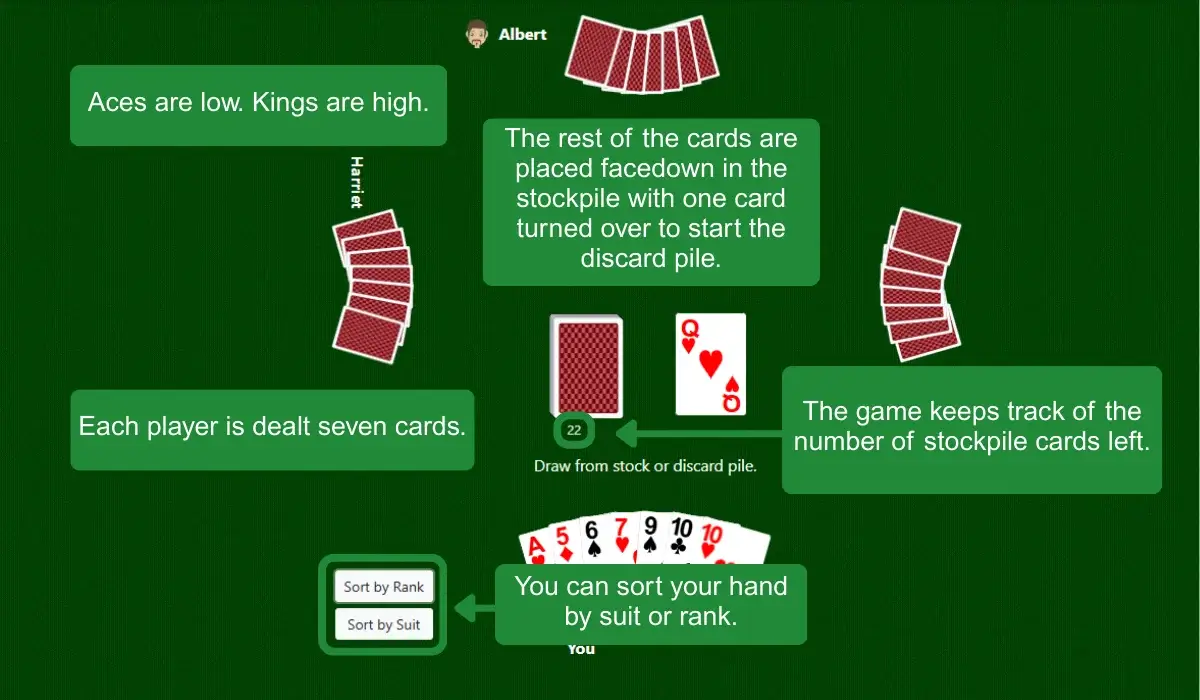
Rummy is a four-player card game that uses a standard 52-card deck, with seven cards dealt to each player. Each round is set up and played as follows:
- Stockpile: After each player is dealt seven cards, the dealer places the remaining 23 cards facedown into the stockpile. Players can choose to draw a single card from this pile during their turn. You can go through the stockpile twice in a round, and the number of cards left in the stockpile is noted so players can keep track.
- Discard pile: The dealer flips the top card from the stockpile to start the face-up discard pile. On your turn, you can take the top card from this pile instead of drawing from the stockpile. At the end of your turn, you must place one card face up on the discard pile, unless you are going out with a meld.
- Sorting: You can sort your hand with the Sort by Rank or Sort by Suit buttons to see your options for melds.
Rummy Terminology
- Round: A new round begins with each deal and ends when a player goes out after they have played all the cards in their hand. Rounds continue until a player reaches 200 points.
- Card values: Aces are low and kings are high. So aces are worth 1 point, and face cards (J, Q, K) are worth 10 points. All other cards are worth their face value (so a 5♣ is worth 5 points).
-
Meld: A group of cards that create a set or run becomes a meld.
- Set: Three or four cards of the same rank, such as Q♣, Q♦, and Q♥
- Run: Three or more sequenced cards of the same suit, such as 8♠, 9♠, and 10♠
- Lay off: You lay off when you play a single card onto an existing meld.
- Going out: After all the cards have been played out of your hand, you go out, and the round ends.
Rummy Rules
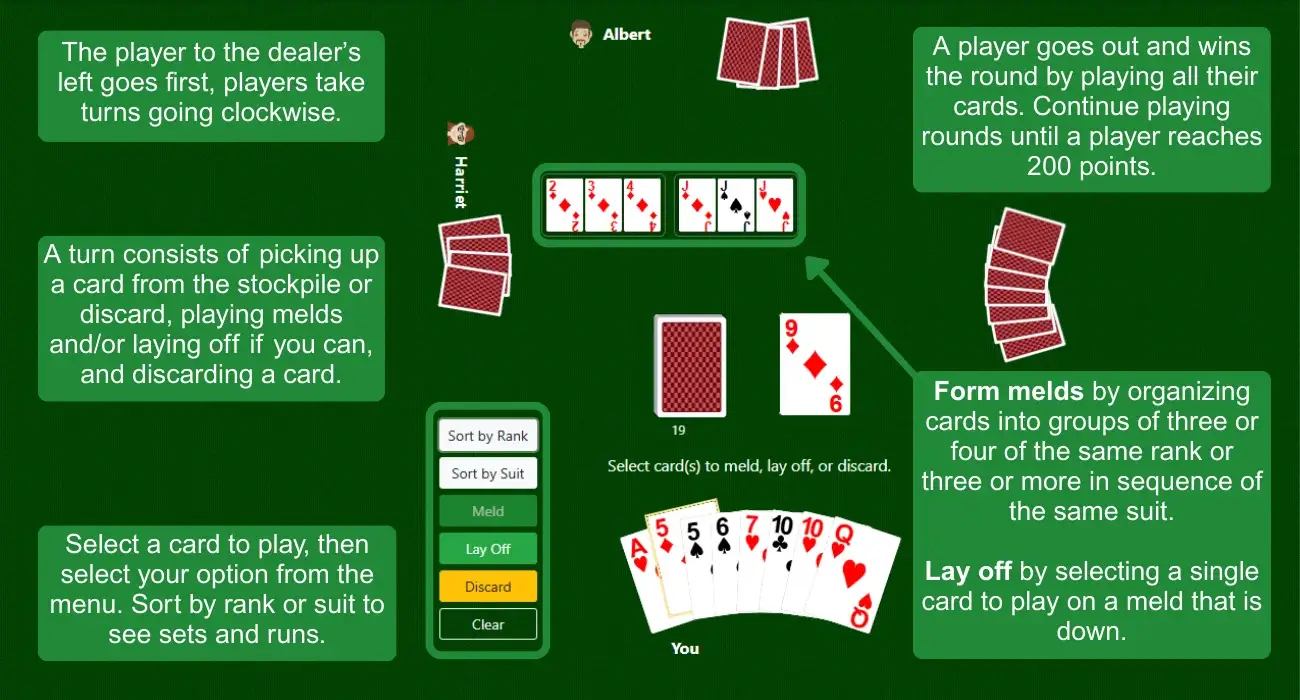
- The player to the left of the dealer goes first. Play continues clockwise with each opponent taking a turn. The dealer changes each round in a clockwise manner.
- A turn consists of drawing, playing, and discarding. Use the menu to the left of your hand to make different plays from the cards you select.
- Drawing: During each turn, you must draw one card from either the stockpile or discard pile. Simply click the card on the pile to draw it.
- Playing: You can then use any cards in your hand to lay down melds (sets or runs) or lay off (play a single card) on other melds already played. Select the cards you want to play, then click “Meld” or “Lay Off” to play them. Note that you can only lay off cards after you’ve played at least one meld, and can lay off as many cards as you want during your turn.
- Discarding: The turn ends by discarding one card. Click the card you want to discard, and then click the yellow “Discard” button. The exception to the discard rule is that if you have just two cards in your hand (for example, Q♣ and Q♠) and the card you draw (Q♥) forms a meld with the two in your hand, you can go out by playing your meld (Q♣, Q♠, Q♥) and not discarding.
- Form melds using sets or runs. A set consists of three or four cards of the same rank (3♣, 3♠, 3♥), and a run consists of three or more sequenced cards of the same suit (9♥, 10♥, J♥). Melds can be played during your turn as soon as you have one, though you can choose to strategically hold them. After a meld has been played, it is open for other players to lay off on.
- Lay off cards individually onto any player’s meld. Laying off means you play a single card, such as an 8♥ onto another meld that has been played, such as 9♥, 10♥, J♥. Once you’ve put down at least one meld, you can lay off as many cards in a turn as possible.
- You can’t discard the same card if you picked it up from the discard pile. If you picked up the top card from the discard pile (for example, 5♦), you can’t discard that same card in that same turn. You can discard the 5♦ on any subsequent turn.
- You can deplete the stockpile twice. If the stockpile is depleted but no player has gone out, the stockpile is turned over and used again. If it is depleted a second time and no player goes out, the round ends in a stalemate.
- Play all your cards to end the round. When one player has played all their cards, the round ends, and scoring is as follows:
- Only the winner of the round scores points. Points scored equal the total point values in all the opponents’ hands. Aces are 1 and face cards are 10. All other cards are counted at face value (so a 2♦ is 2 points, but a 9♦ is nine points).
- Stalemate: If the stockpile is depleted twice, the game ends with no winner, and no points are awarded to any player.
- Continue playing rounds until a player reaches 200 points and wins the game.
Rummy Strategies
- Use multiples of what you have in your hand to build potential melds. Use what you have in your hand to create melds, but don’t try creating from scratch with singles. For example, if you have a Q♣ and Q♥ then go for a set of queens, but if you have just the Q♠, use the Q♠ as a discard instead of hoping to build a set from just the one card.
- Build flexible melds instead of committing to a single set or run. If you have an opportunity to keep melds flexible, you increase the chances of forming a meld. For example, if you have a 4♣, 4♠, and 3♣, this enables you to get either a 2♣, 5♣, 4♥, or 4♦ to create a meld. You often double your chances of making a meld when you build with flexibility.
- Limit hand points when players have just three or fewer cards. Any player with three or fewer cards could go out on their next turn. A player with three cards likely has a near set; a player with two cards likely has one as well because you don’t have to discard when all your cards are matched; and a player with just one card can simply lay off to go out. Unless you know you have a good chance of matching high-ranking cards in your hand, you’re better off dumping those cards and strategizing to lay off or rebuild melds with lower points. That way, you’re not caught with a lot of points in your hand if an opponent goes out.
- Change play based on melds played. The melds played can tell you whether you should have a meld-heavy, lay-off-heavy, or hybrid hand. For example, when the A♣, 2♣, 3♣, 4♣ as well as the 5♣, 5♠, 5♥, 5♦ have been played, this signals that no lay-off options are left because the melds are locked. You need to focus on creating melds with your hand until the playable melds change. But if several sets have just three cards and runs are open-ended (playable on both ends), you have many more potential lay-off options. So pay attention to how the melds change with each turn and adjust your hand.
- Use the discard pile to finish melds. If you have a 5♣ and a 5♠ is discarded by the player before you, don’t pick it up to simply form a pair. This signals to players that you’re looking for fives or spades. Instead, use the discard pile to only finish a meld. So, if you have the 5♣ and 5♥ and the 5♠ is discarded, then pick it up for a set.
- Watch what players are drawing from the discard pile. Players signal their needs (what melds they’re strategizing for) when they pick up from the discard pile. What players pick up can inform how you play your hand. For example, if you see them pick up a 10♦ and you have a pair of tens, you can be fairly confident that they are creating a run with diamonds. You can either keep near diamonds (9♦ and J♦) that you might use to lay off on their meld, which you might do earlier in the round, or dump them to make their meld more difficult to create or impossible, which makes sense when players have fewer cards.
- Watch what players are discarding and playing. Your options decrease and increase by the cards discarded and played. If you’re holding the 9♣ and 9♥ and someone plays a meld with or discards a 9♦, you know you only have the 9♠ that can finish your meld. So as the game progresses, you have to decide if it’s worth holding out for one card or if you need to adjust.
Sometimes you just want to compete against other people, and you’re at no shortage for multiplayer card games, like Spades or Whist, on Solitaired!
