The 18 Best Card Games for Kids: Easy to Learn, Fun to Play
By Neal Taparia - Published: 11/24/2025
A standard deck of cards may look simple, but for kids it’s a ticket to hours of fun. From learning their first Go Fish match to racing through a round of Slapjack, card games have a way of turning rainy afternoons or family game nights into lasting memories. And these games aren’t just entertaining, they help kids practice patience, memory, and even math skills, all while giving families a chance to connect.
To make things even easier, Solitaired offers kid-friendly classic card games like Solitaire and Spades online, so children can jump into the fun anytime. No setup, no missing cards, just pure play.
The 18 Best Card Games for Kids
One of the best things about card games is how versatile they are. There’s something for every age and skill level. Younger kids love simple matching games, while older kids and teens often enjoy strategy and trick-taking challenges. To help you find the right fit, here’s a quick overview of the 18 best kid-friendly card games, organized by age group and level of difficulty.
| Card Game | Best Age Group | Difficulty | # of Players | Play Style |
|---|---|---|---|---|
| Go Fish | 4 to 6 | Easy | 2 to 6 | Matching, memory |
| Old Maid | 4 to 6 | Easy | 2 to 6 | Matching, chance |
| Memory Match | 4 to 6 | Easy | 2 to 6 | Memory, matching |
| Snap | 4 to 6 | Easy | 2 to 6 | Speed, reflex, matching |
| War | 4 to 6 | Easy | 2 | Luck / chance |
| Crazy Eights | 7 to 9 | Easy | 2 to 6 | Matching, strategy, planning |
| Slapjack | 7 to 9 | Easy | 2 to 6 | Speed, reflex |
| Spoons | 7 to 9 | Easy | 3+ | Speed, reflex, matching |
| Gin | 10 to 12 | Medium | 2 | Strategy, planning, matching |
| Solitaire | 10 to 12 | Medium | 1 | Strategy, planning, pattern, sequencing |
| Speed | 10 to 12 | Medium | 2 | Reflex, sequencing, fast-paced play |
| Trash | 10 to 12 | Medium | 2+ | Sequencing, luck, strategy |
| Rummy | 10 to 12 | Medium | 2 to 6 | Strategy, planning, matching |
| I Doubt It | 10 to 12 | Medium | 3+ | Bluffing, deception, memory |
| Cribbage | 13+ | Medium | 2 to 4 | Strategy, counting, pattern recognition |
| Hearts | 13+ | Medium/hard | 4 | Trick-taking, strategy, planning |
| Spades | 13+ | Medium/hard | 4 (partners) | Trick-taking, teamwork |
| Euchre | 13+ | Medium/hard | 4 (partners) | Trick-taking, teamwork |
This mix of classics and kid-friendly favorites shows how card games can grow right along with your child. Whether it’s matching games for young kids or strategy-packed challenges for teens, there’s always a new favorite card game waiting in the deck.
Best Card Games for Ages 4 to 6 (Pre-K & Early Elementary)
Four to six year old kids are just beginning to understand rules, take turns, and recognize patterns. The best card games for preschoolers and early elementary kids are simple, fast-paced, and full of fun surprises. These games use matching, memory, and a little bit of luck to keep kids engaged without overwhelming them.
1. Go Fish
- Difficulty Level
- Easy
- Number of Players
- 2 to 6
- Game Time
- 10 to 20 minutes
- Deck of Cards Used
- Standard 52-card deck (remove face cards to simplify if needed)
- Game Objective
- Collect sets of four matching cards by asking other players or drawing from the pile.
How to Play:
Each player is dealt five cards (4+ players) or seven cards (2–3 players), with the rest forming a draw pile in the center. On a turn, a player asks another for a specific rank as long as they have at least one card of that rank in their hand (e.g., “Do you have any threes?”).
If the other player has one or more, they must hand them over, and the asker continues their turn. They can ask the same player or another player for a specific rank. If the player doesn’t have the requested rank, the reply is “Go Fish,” and the asker draws a card from the pile. Whenever a player collects four of a kind, they lay the set down. Play continues until all sets are made, and the player with the most sets wins.
Why Kids Love It:
Go Fish is easy to learn and gives little ones a sense of accomplishment as they make matches. It’s also a great introduction to memory skills.
2. Old Maid
- Difficulty Level
- Easy
- Number of Players
- 2 to 6
- Game Time
- 10 to 15 minutes
- Deck of Cards Used
- Standard deck with one queen removed
- Game Objective
- Avoid being the last player holding the unmatchable “Old Maid” card.
How to Play:
Remove a queen and then deal the remaining cards evenly among players. Each player looks for pairs in their hand and lays them down. On each turn, a player offers their hand facedown to the player on their left, who selects one card. If it forms a pair, that player discards it. Play continues around the circle until all pairs are matched, leaving one unlucky player holding the queen (the Old Maid).
Why Kids Love It:
The suspense of drawing cards and trying to avoid the Old Maid leads to lots of laughter, and it’s a playful way to teach chance and matching.
5. War
- Difficulty Level
- Easy
- Number of Players
- 2
- Game Time
- 15 to 30 minutes
- Deck of Cards Used
- Standard 52-card deck
- Game Objective
- Win all the cards by playing higher values.
How to Play:
Shuffle the deck and lay all cards facedown in neat rows. On their turn, each player flips over two cards. If the cards match in rank (two kings, two sevens, etc.), the player keeps the matching cards and takes another turn. If they don’t match, the cards are flipped facedown again, and play passes to the next player. The game continues until all pairs have been collected. The player with the most pairs at the end wins.
Why Kids Love It:
Memory Match is simple, but it rewards focus and sharp memory. Kids love the “aha!” moment of flipping over a card they remembered.
4. Snap
- Difficulty Level
- Easy
- Number of Players
- 2 to 6
- Game Time
- 5 to 10 minutes
- Deck of Cards Used
- Standard 52-card deck
- Game Objective
- Be the first to call “Snap!” when two identical cards appear back-to-back.
How to Play:
The dealer divides the deck evenly among players. Each player places their stack facedown in front of them. Starting with the first player, cards are flipped one by one into a shared pile. When two cards of the same rank appear consecutively, the first person to shout “Snap!” and slap the pile collects the cards. If two players shout at once, the pile is set aside as a “Snap Pot,” and the next winner takes it. The game continues until one player has all the cards or until everyone decides to stop.
Why Kids Love It:
Snap is high energy, quick, and rewards fast reflexes. It’s perfect for kids with short attention spans and makes for hilarious, lighthearted rounds.
5. War
- Difficulty Level
- Easy
- Number of Players
- 2
- Game Time
- 15 to 30 minutes
- Deck of Cards Used
- Standard 52-card deck
- Game Objective
- Win all the cards by playing higher values.
How to Play:
The deck is split evenly between two players, who keep their cards facedown in a stack. At the same time, both players flip over the top card. The higher card wins the round, and the winner takes both cards, placing them at the bottom of their pile. If the cards are equal, a “war” begins: Each player places three cards facedown, then flips the next card. The higher card wins all the cards in play. The game continues until one player has all the cards or everyone agrees to stop.
Why Kids Love It:
War is pure luck, so kids don’t need strategy to win. The suspense of “wars” makes it especially exciting.
Best Card Games for Ages 7 to 9 (Elementary)
By the time kids reach elementary school, they’re ready for games with a bit more structure. These card games introduce light strategy, encourage focus, and add a little competition, while still being easy enough for kids to pick up quickly.
6. Crazy Eights
- Difficulty Level
- Easy
- Number of Players
- 2 to 6
- Game Time
- 15 to 25 minutes
- Deck of Cards Used
- Standard 52-card deck
- Game Objective
- Be the first to get rid of all your cards.
How to Play:
Deal five cards (3+ players) to seven cards (2 players) to each player and place the remaining cards in a draw pile. Flip the top draw pile card face-up to form the discard pile. On their turn, each player must play a card that matches the top card in rank or suit (for example, if the top card is a five of hearts, you can play any five or any heart). Eights are “wild,” meaning a player can put down an eight at any time and choose a new suit that the next player must play. If a player can’t make a move, they draw from the pile until they can play. The first player to discard all their cards wins.
Why Kids Love It:
The wild eights keep everyone on their toes, and kids enjoy the balance of luck and simple strategy.
7. Slapjack
- Difficulty Level
- Easy
- Number of Players
- 2 to 6
- Game Time
- 10 to 20 minutes
- Deck of Cards Used
- Standard 52-card deck
- Game Objective
- Capture all the cards by being the first to slap jacks.
How to Play:
Deal the entire deck evenly among players. Without looking at their cards, each player keeps their stack facedown. Going around the circle, players flip one card at a time into a shared pile in the center. When a jack appears, players race to slap the pile. The first to slap it collects all the cards, adds them to their stack, and shuffles the stack. If someone slaps incorrectly, they must give a card to the player who flipped. The game continues until one player has all the cards.
Why Kids Love It:
Slapjack combines speed, focus, and laughter. The race to slap the jack creates bursts of excitement that kids can’t get enough of.
8. Spoons
- Difficulty Level
- Easy
- Number of Players
- 3+
- Game Time
- 10 to 20 minutes
- Deck of Cards Used
- Standard 52-card deck (plus one fewer spoon than players)
- Game Objective
- Collect four of a kind, then grab a spoon before others do.
How to Play:
Place one fewer spoon than the number of players in the center of the table. Deal four cards to each player and place the remaining stack next to the dealer. The dealer draws one card from the stack, which they can add to their hand or pass, keeping only four cards in their hand at a time. The discard is passed to the player on the left, who either keeps it or passes it along.
The draw and discard cycle continues quickly around the table until someone gets four of a kind and grabs a spoon. As soon as one player grabs a spoon, everyone else scrambles for one. The player left without a spoon is eliminated. Play continues until only one player remains.
Why Kids Love It:
Spoons is chaotic, physical, and hilarious. The scramble for spoons makes it a guaranteed crowd-pleaser at family game night.
Best Card Games for Ages 10 to 12 (Upper Elementary/Middle School)
At this age, kids are ready for games that add more strategy, planning, and memory skills. These card games challenge them to think ahead while still being fun and approachable.
9. Gin
- Difficulty Level
- Medium
- Number of Players
- 2
- Game Time
- 20 to 30 minutes
- Deck of Cards Used
- Standard 52-card deck
- Game Objective
- Be the first player to score 100 points by arranging all the cards in your hand into valid sets or runs.
How to Play:
Each player is dealt ten cards. The remaining cards form a stockpile, with the top card turned over to start the discard pile. On their turn, a player draws one card from the stock or discard pile and discards one card. Players keep their sets (three or four cards of the same rank) and runs (three or more consecutive cards of the same suit) hidden in their hands until the end of the round.
A round can end when a player “knocks” (showing their cards with 10 or fewer unmatched points, also known as deadwood) or goes “gin” (all cards form valid sets/runs). Number cards are worth their face value, face cards are 10 points, and aces are one point.
The player with the fewest deadwood points wins the round and gets points equal to the difference between each player’s deadwood. If a player goes gin, they score 25 bonus points, plus all the opponent’s deadwood. The first player to reach 100 wins.
Why Kids Love It:
Gin feels like a more “grown-up” game, but the simple rules make it accessible. It’s a great stepping stone toward more strategic card play.
10. Solitaire
- Difficulty Level
- Medium
- Number of Players
- 1
- Game Time
- 5 to 15 minutes
- Deck of Cards Used
- Standard 52-card deck
- Game Objective
- Build ordered foundations by suit, starting from ace and ending with king.
How to Play:
Shuffle the deck and deal seven columns of cards, with the first column having one card, the second two cards, and so on. Only the top card of each column is face up. The rest of the deck becomes the stockpile. Players arrange cards in descending order, alternating colors (red on black, black on red), and move cards between columns to reveal new cards. Aces are placed in foundation piles, which are built up by suit in ascending order. Cards are flipped from the stockpile to the waste pile and can be used when players get stuck.
The game is won when all cards are moved to the foundations. For step-by-step instructions and variations, visit Solitaired’s guide on how to play Solitaire.
Why Kids Love It:
Solitaire is a solo challenge that builds patience, focus, and problem-solving. It’s also a great option for quiet play, and kids can play Solitaire online without worrying about setup or misplaced cards.
11. Speed
- Difficulty Level
- Medium
- Number of Players
- 2
- Game Time
- 5 to 10 minutes
- Deck of Cards Used
- Standard 52-card deck
- Game Objective
- Get rid of all your cards before your opponent.
How to Play:
Each player is dealt a stack of 20 cards, with 5 in hand. Between each player, two cards are placed face down and two piles of five cards are placed on either side of them. To begin the game, each player turns a center card face up.
Players race simultaneously, placing cards from their hand onto either pile if they are one rank higher or lower (for example, a six can be played on a five or seven). Players refill their hand from their stack as they play and if both are stuck they flip cards from the outer five-card piles face up into the center piles. The first to empty their stack wins.
Why Kids Love It:
Speed is exactly what it sounds like: fast, frantic, and competitive. It’s great for kids who love high-energy challenges.
12. Trash
- Difficulty Level
- Medium
- Number of Players
- 2+
- Game Time
- 10 to 15 minutes
- Deck of Cards Used
- Standard 52-card deck (use two decks for 3+ players)
- Game Objective
- Be the first to build a sequence from ace through ten.
How to Play:
Deal 10 cards facedown to each player in two rows of five. Place the rest of the deck in the center as a draw pile. On their turn, a player draws a card and uses it to fill the correct position if possible (ace = first slot, two = second slot, etc.). Jacks are wild and can fill any slot. Kings and queens are trash.
If a card fits an open slot on the grid, place it face up in that slot. Then, flip over the facedown card that was in that spot. If the flipped card can be placed somewhere else in the grid, place it and continue flipping until you reveal a card that doesn’t fit. If the drawn card doesn’t fit, it’s discarded.
The next player can draw from the draw pile or discard pile and place cards in their grid. Players take turns and the first player to complete the 1 through 10 sequence wins the game.
Why Kids Love It:
Trash is simple but addictive. Kids love the surprise of flipping cards and the race to complete their sequence first.
13. Rummy
- Difficulty Level
- Medium
- Number of Players
- 2 to 6
- Game Time
- 15 to 30 minutes
- Deck of Cards Used
- Standard 52-card deck
- Game Objective
- Have the lowest score once a player reaches 100 points.
How to Play:
Each player is dealt seven cards (ten in a two-player game). The remaining cards form a draw pile, with the top card placed face up to start the discard pile. On their turn, players draw one card from either the draw pile or discard pile, then discard one card. Players lay down sets (three or four cards of the same rank) or runs (three or more consecutive cards in the same suit) as they form them. They can also add to sets and runs already on the table.
The round ends when a player lays down all their cards and discards their last one. Other players score penalty points for cards left in hand. Numbered cards are worth their face value, face cards are worth 10, and aces are worth 15. You continue to play additional rounds until a player reaches 100. Then, the player with the lowest score wins.
Why Kids Love It:
Rummy keeps kids engaged because they get to actively lay down cards and watch their sets grow. The mix of luck and strategy makes every round exciting.
15. I Doubt It (AKA: Bullsh*t)
- Difficulty Level
- Medium
- Number of Players
- 3+
- Game Time
- 15 to 30 minutes
- Deck of Cards Used
- Standard 52-card deck
- Game Objective
- Be the first to get rid of all your cards by playing them facedown without getting caught bluffing.
How to Play:
Deal all cards evenly among players. On their turn, each player places one or more cards facedown in the center, declaring their amount and rank (e.g. “two sevens”). Players must call ranks in ascending order (aces, then twos, then threes, and so on). Other players may challenge by saying “I doubt it” or “bullsh*t.” If the player was lying, they pick up the pile; if they told the truth, the challenger picks it up. Play continues until someone empties their hand.
Why Kids Love It:
I Doubt It is pure fun. Kids love the bluffing, the drama of calling out a lie, and the laughter when someone gets stuck with a huge pile.
Best Card Games for Teens (Ages 13+)
By the time kids are teenagers, they’re ready for card games that involve deeper strategy, teamwork, and long-term planning. These games often take a little longer to learn but reward players with layers of strategy and collaboration that make them endlessly replayable.
15. Cribbage
- Difficulty Level
- Medium
- Number of Players
- 2 to 4
- Game Time
- 25 to 45 minutes
- Deck of Cards Used
- Standard 52-card deck (plus a Cribbage board for scoring)
- Game Objective
- Be the first player to reach 121 points by forming scoring combinations of cards during play and in hand.
How to Play:
Players are each dealt six cards, from which they choose two to place facedown into a separate pile called “the crib.” One card from the remaining deck is turned face up, and play begins. Players take turns laying down cards, keeping a running total of their values (without exceeding 31). Points are scored for pairs, runs, and certain totals (like 15).
After all cards are played, players also score combinations in their hands and in the crib. The game continues until one player reaches 121 points, tracked on the cribbage board. For a detailed walkthrough of scoring and strategy read our guide on how to play Cribbage and then play Cribbage online.
Why Kids Love It:
Cribbage combines quick counting with deeper planning. The online version of Cribbage on Solitaired makes it easier by handling the math, letting teens focus on strategy.
16. Hearts
- Difficulty Level
- Medium / Hard
- Number of Players
- 4
- Game Time
- 30 to 60 minutes
- Deck of Cards Used
- Standard 52-card deck
- Game Objective
- Score the fewest points by avoiding hearts and the queen of spades.
How to Play:
Deal all the cards evenly among the four players, then each passes two cards from their hand to another player. The player with the two of clubs leads the first trick. Players must follow suit if possible. For example, every other player must also play a club if they have one.
If not, they may play another card. There is no trump suit in Hearts (the highest card of the leading suit always wins the trick). If you win a trick with a penalty card (any heart and the queen of spades), you’re assigned penalty points. The game continues until a player reaches 100 points, and the player with the lowest score wins. For complete rules and scoring strategies, visit our guide on how to play Hearts.
Why Kids Love It:
Hearts mixes strategy with a bit of bluffing, and the rotating pass keeps every round unpredictable. The online version of Hearts on Solitaired makes it simple to learn and play because scoring and rules are handled automatically.
17. Spades
- Difficulty Level
- Medium / Hard
- Number of Players
- 4 (partners)
- Game Time
- 30 to 60 minutes
- Deck of Cards Used
- Standard 52-card deck
- Game Objective
- Work with your partner to win the number of tricks you bid.
How to Play:
Each player is dealt 13 cards. Before play begins, players take turns bidding on how many tricks they think they’ll win. Spades is always the trump suit, beating all others. On each turn, players must follow suit if possible; if not, they can play any card, including a spade.
Tricks are won by the highest card of the leading suit or the highest spade. Teams score points by meeting their bids, but missing a bid results in penalties. For complete rules, bidding strategies, and scoring details, visit Solitaired’s guide on how to play Spades.
Why Kids Love It:
Spades rewards teamwork and careful planning. Teens enjoy the challenge of predicting outcomes and coordinating with a partner. Solitaired offers an easy way to play Spades with built-in scoring and clear rules.
18. Euchre
- Difficulty Level
- Medium / Hard
- Number of Players
- 4 (partners)
- Game Time
- 20 to 30 minutes
- Deck of Cards Used
- 24-card deck (9 through ace)
- Game Objective
- Be the first team to score 10 points by winning tricks.
How to Play:
Each player is dealt five cards. The top card of the remaining deck is flipped over to suggest a possible trump suit. Starting with the player to the dealer’s left, players can “order up” that suit or pass. If everyone passes, a new trump selection round begins.
Once trump is chosen, players compete to win tricks, with the highest trump card winning. The rank order in Euchre is unique: the jack of the trump suit (the “right bower”) is the highest card, followed by the jack of the same color (the “left bower”), then ace, king, queen, 10, and 9.
Points are scored by the team that makes trump if they win at least three tricks; if not, the other team scores. To learn more about bidding, trump selection, and scoring, check out Solitaired’s guide on how to play Euchre.
Why Kids Love It:
Euchre blends teamwork, bidding, and fast-paced tricks. It’s quick to play and full of moments where clever strategy pays off.
The Benefits of Playing Card Games for Children’s Development
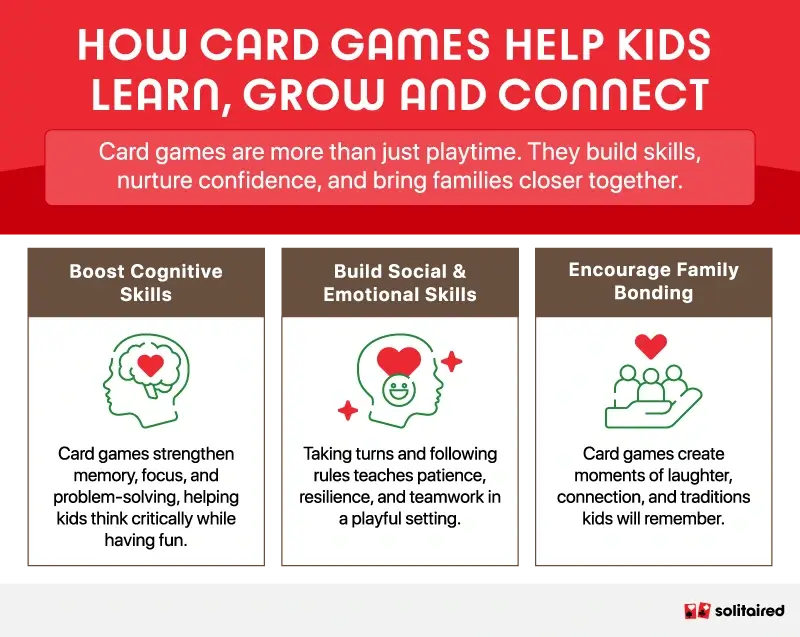
Card games and board games aren’t just fun. They’re little learning labs disguised as play. Whether it’s a preschooler matching pairs in Go Fish or a tween planning a strategy in Rummy, every game helps kids build skills that extend far beyond the table.
Cognitive Skills: Sharpening Young Minds Through Play
Card games are a natural way to strengthen memory, attention, and problem-solving. Games like Memory Match train kids to focus and recall, while strategy games like Klondike Solitaire and Rummy encourage planning several steps ahead. Even simple counting and comparing in games like War help reinforce basic math concepts in a fun, low-pressure setting.
Social and Emotional Skills: Patience, Teamwork, and Sportsmanship in Action
Learning to take turns, follow rules, and manage the ups and downs of winning and losing builds patience and resilience. Games like Slapjack and Crazy Eights encourage quick reactions and sportsmanship, while partner-based games such as Spades teach cooperation and communication. Studies have even shown that structured gameplay like card games supports emotional regulation in children.
Family Bonding: Turning Game Night into Family Time
Card games may be a lot of fun, but they also bring families closer together. They create opportunities for connection, laughter, and shared traditions for the whole family, across generations. At the same time, digital platforms like Solitaired offer a modern balance, giving kids the chance to practice and play fun card games independently while still enjoying the same timeless games parents know and love.
A Safe Space for Kids to Play Online
Playing with a real deck of cards is a classic experience, but sometimes kids just want to dive straight into the fun. Online card games make that possible. There’s no shuffling and no waiting, just instant play at the click of a button.
That’s exactly what Solitaired delivers. The platform offers kid-friendly favorites like Solitaire, Hearts, Spades, and other classic games like mahjong in a safe, ad-light environment. Built-in rules guide kids as they play, making it easy for them to learn without constant reminders. And because everything is digital, there’s no risk of losing cards or struggling with setup. It’s a smooth and engaging way to enjoy timeless games anytime, anywhere.
For parents, Solitaired offers peace of mind. Kids are entertained, challenged, and practicing valuable skills in a space designed for safe, screen-time play.
Tips to Keep Kids Coming Back for More
Choosing the right card game for your child can make the difference between frustration and hours of fun. Here are a few simple ways to set kids up for success:
- Match the game to your child’s stage. Younger kids thrive with easy, visual games like Go Fish or Old Maid, while older kids can handle more strategic challenges like Rummy or Hearts.
- Start simple, then add complexity. Begin with the basics, and once your child feels confident in their favorite card game, introduce variations or slightly more advanced games to keep things engaging.
- Mix offline and online play. Traditional family game nights build connection, while platforms like Solitaired let kids enjoy classics like Solitaire and Spades on their own, anytime, anywhere.
- Focus on fun, not perfection. The real goal of family card games is laughter, learning, and shared time together. Winning and losing are just part of the experience.
The Joy of Play, Anytime and Anywhere
Card games have stood the test of time for a reason. They’re simple to learn, endlessly adaptable, and bring out the best mix of fun and learning for kids of every age. From the first thrill of calling out “Go Fish!” to the strategy of Rummy or the teamwork of Spades, these games grow right alongside children, giving them new challenges as they get older.
Beyond the fun, card games strengthen memory, teach patience, and create moments of connection that kids will carry with them for years. And with Solitaired, families can keep the tradition alive in a modern way that’s safe, easy-to-use, and always ready for play. Whether it’s shuffling a real deck at the kitchen table or clicking into a quick round online, card games remain one of the simplest and most rewarding ways to learn, laugh, and play together.
About the author