Play Baker's Game Solitaire
Enjoy Baker's Game Solitaire online for free. A harder version of FreeCell, this is the perfect game to level up your Solitaire skills, with hints provided when you get stuck.
Baker's Game Objective
To win Baker's Game you must complete four foundation piles by sequencing cards by suit in ascending order, from ace to king.
Baker's Game Setup
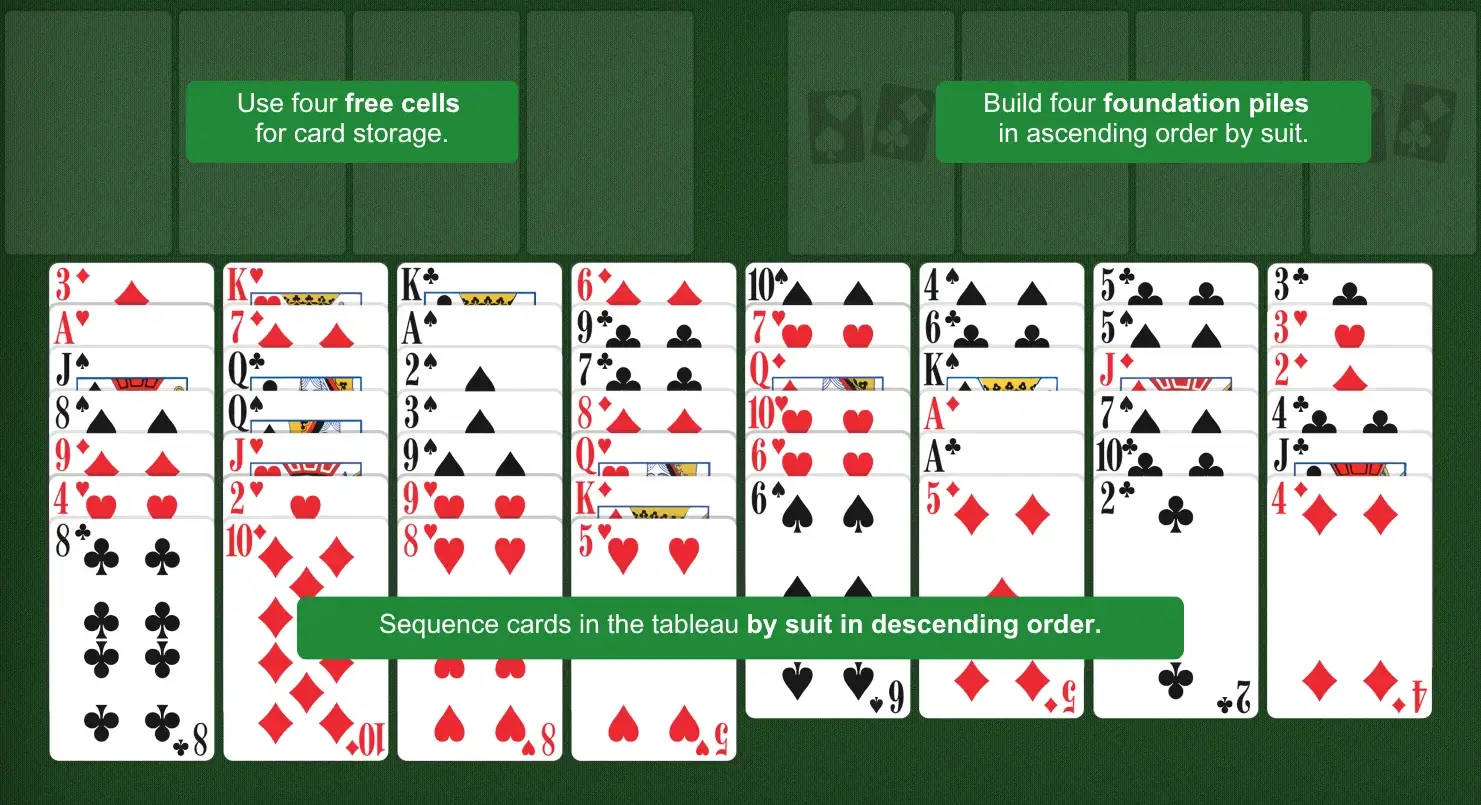
Set up Baker's Game with a single 52-card deck and using three main areas:
- Tableau: All 52 cards are dealt face up into eight columns in the tableau, with the first four columns containing seven cards and the last four columns six. You use this area to sequence same-suit cards into descending order.
- Free cells: You can use the four free cells above the tableau as a temporary placeholder when you arrange cards.
- Foundation piles: Above the top-right area of the tableau, you arrange cards in ascending order into four foundation piles, one for each suit. Start each pile with an ace and continue building until you complete it with a king. After all four foundation piles are finished, you win the game.
Baker's Game Rules
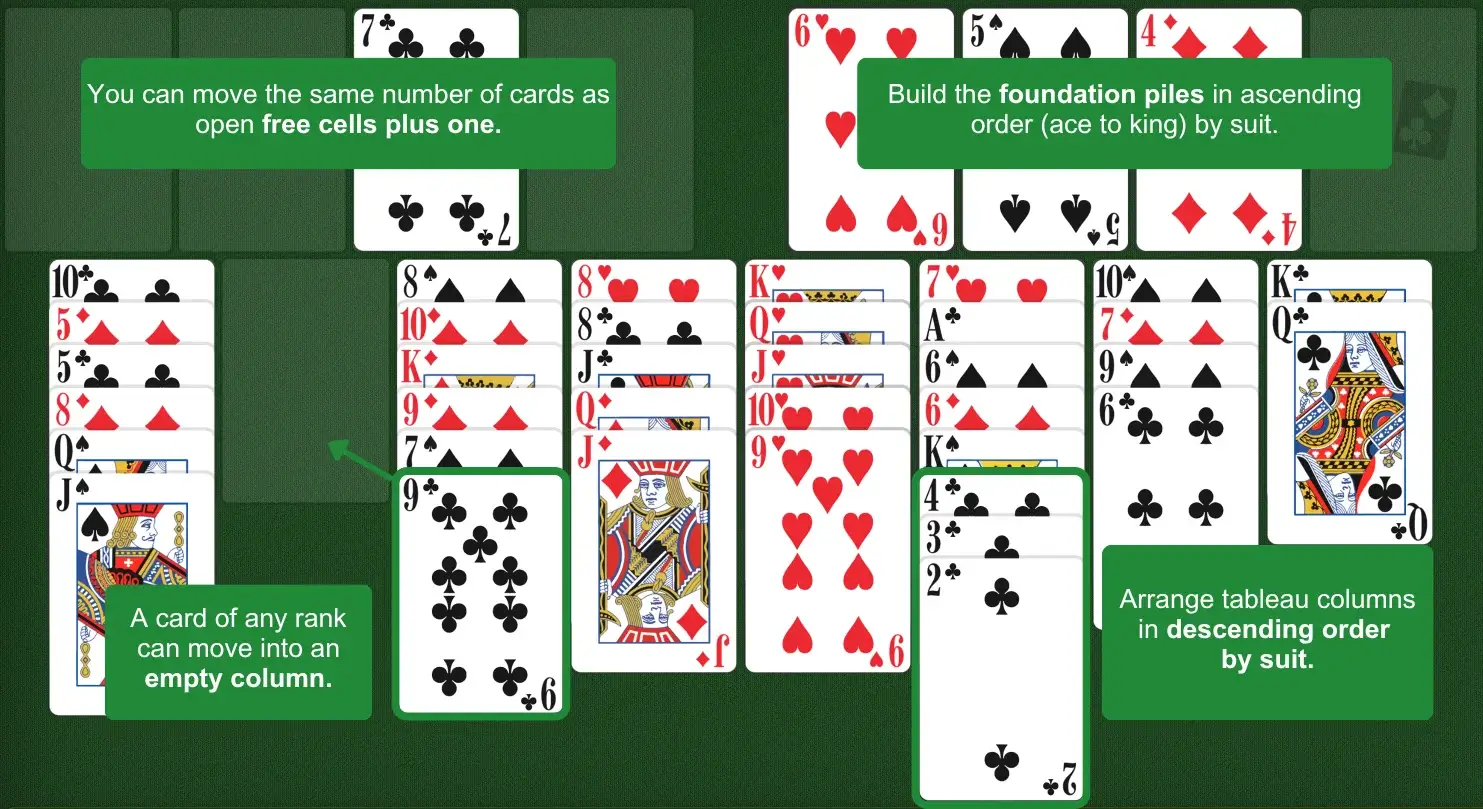
- Sequence same-suit cards in descending order. Arrange cards in the tableau by placing them in descending order by suit. For example, you can place a 9♥ on a 10♥.
- The number of sequenced cards you can move is equal to the number of open free cells plus 1. If only two free cells are open, you can only move a sequence of three same-suit cards. If you only have one cell open, you can only move two cards.
- Any card or sequence can move into an empty column. Regardless of rank, you can move any card or sequence that follows the free cell plus 1 rule into an open column..
- Start every foundation pile with an ace. Because foundation piles ascend in order, you must start them with an ace and build them up to king.
Baker's Game Strategies
- Identify blocked cards first and plan ahead. Since each card can only connect to one matching card in sequence, blocked cards can stop your progress quickly. Look for buried aces that can prevent you from moving cards into foundation piles and buried high-ranking cards like kings that affect your ability to build long sequences.
- Focus on emptying columns. Empty columns give you extra room to rearrange cards, break apart stacks, and build longer sequences. Clearing a column should often be one of your top priorities because it creates flexibility for future moves.
- Use high-ranking cards in empty columns. If you're prioritizing empty columns, don't waste that space. High-ranking cards like face cards and tens can help you build long sequences that pull out cards from other columns and free up cards you need.
- Keep long sequences in empty columns and short sequences in all others. Creating a sequence means moving more than one card, and to do that, you need enough free cells open. So give your gameplay more flexibility by sticking to long sequences (five cards or more) in the empty columns and keeping them shorter (four cards or fewer) in regular columns so that you don't block the unsequenced cards.
- Move cards to foundation piles as soon as they're available. You won't affect your sequencing in the tableau by moving cards to their foundations. By moving cards to their foundation pile when they become available, you help move cards out of the tableau giving you more space to work with.
- Have a plan to move cards out of free cells. Think of free cells as temporary storage. If you move cards to free cells without a plan, you could end up having them stuck there, taking up valuable space you need for card movement. Moving too many cards into free cells with no plans of getting them back into play will get you stuck quickly.
If Baker's Game is too hard, you might find FreeCell is an easier variation, but if you are enjoying the challenge, you can try Spider Solitaire or Yukon for even more of a challenge. Play all of these for free on Solitaired!
