Solitaire in Paintings: Explore 8 Paintings Across Centuries
By Neal Taparia - Published: 04/09/2026
Long before it became a default feature on computers and phones, Solitaire, historically known as Patience, was already part of everyday life. By the 19th century, people across Europe were quietly laying out cards on tables, playing alone, absorbed in a game built on sequence, control, and repetition. What’s less obvious is how long it took for that kind of play to appear in art.
For centuries, paintings that included cards focused almost entirely on social scenes: groups gathered around tables in taverns or dim interiors, where the game carried tension, risk, or moral undertones. Card play was something to be watched, a performance of luck, sometimes deception, and often a reflection of human behavior. A still life of a person playing alone, silently working through a spread of cards, offered none of that drama.
Solitaire didn’t suddenly emerge in the 19th century, but it belonged to a different kind of space: private, domestic, and often invisible. As leisure shifted indoors and became more closely tied to class structure and gender roles, particularly in Victorian Europe, so did the moments artists chose to depict. Quiet activities like reading, sewing, and eventually the game of Solitaire began to reflect not just how people passed time, but how society expected them to.
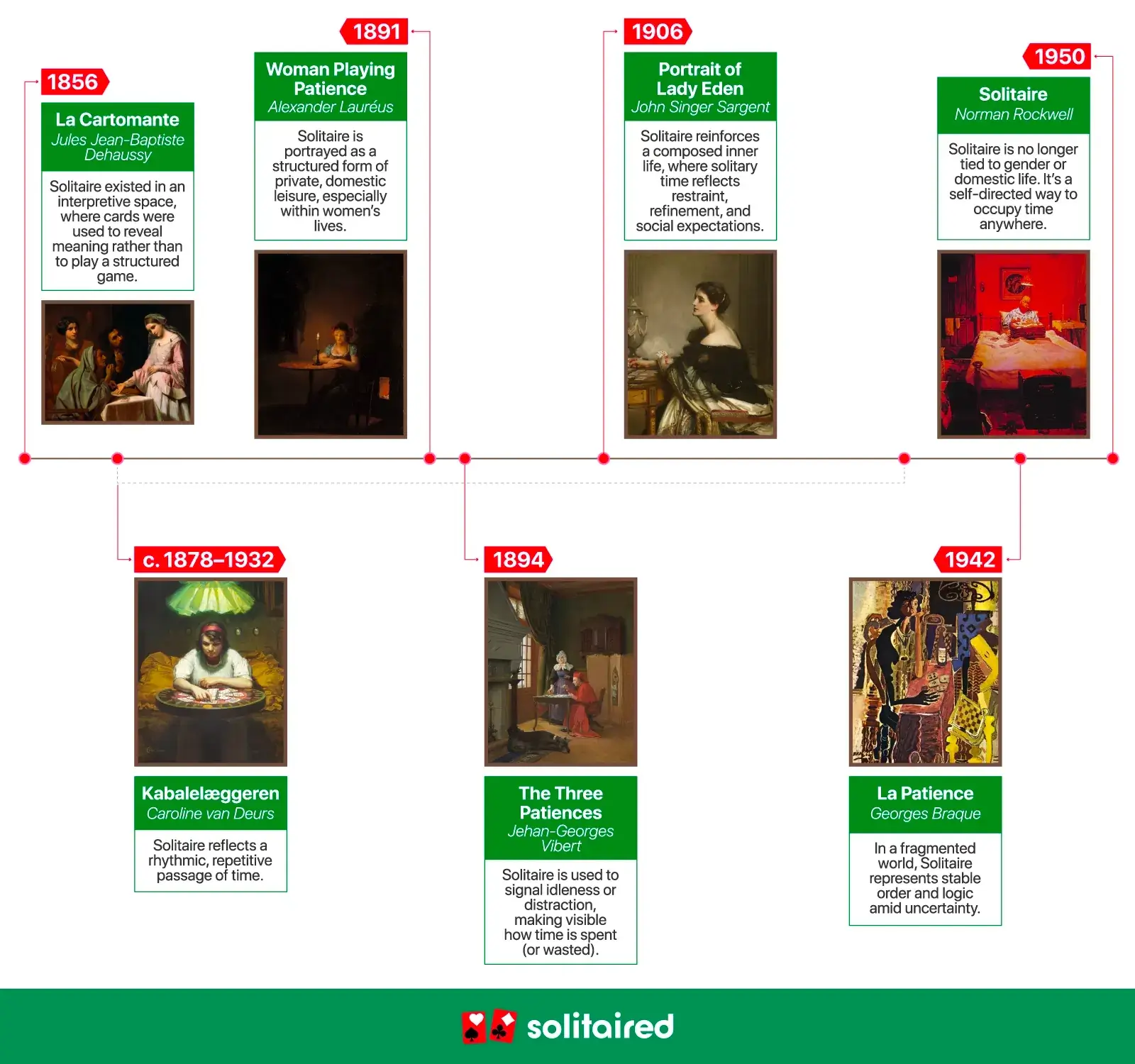
When Solitaire finally appears in paintings, it does more than show a game. It reveals how people spent time when no one was watching—how solitude was structured, who was allowed to occupy it, and how those boundaries changed over time.
Before It Was a Game, Solitaire Was a Form of Interpretation
Before Solitaire became widely recognized as a structured pastime, the early history of Solitaire reveals that card tableaus and outcomes were often associated with fortune-telling and interpretation. In that setting, the act of laying out cards was not about winning or losing. It was about finding meaning.
That connection helps explain why Solitaire card games are so difficult to identify in earlier paintings. Artists were drawn to scenes of interaction—games played between people, filled with risk, deception, or spectacle. A quiet arrangement of cards, handled by a single person and interpreted rather than contested, didn’t fit those fine art conventions.
1. La Cartomante by Jules Jean Baptiste Dehaussy (1856)
Before Solitaire was about revealing cards, it was about revealing meaning.
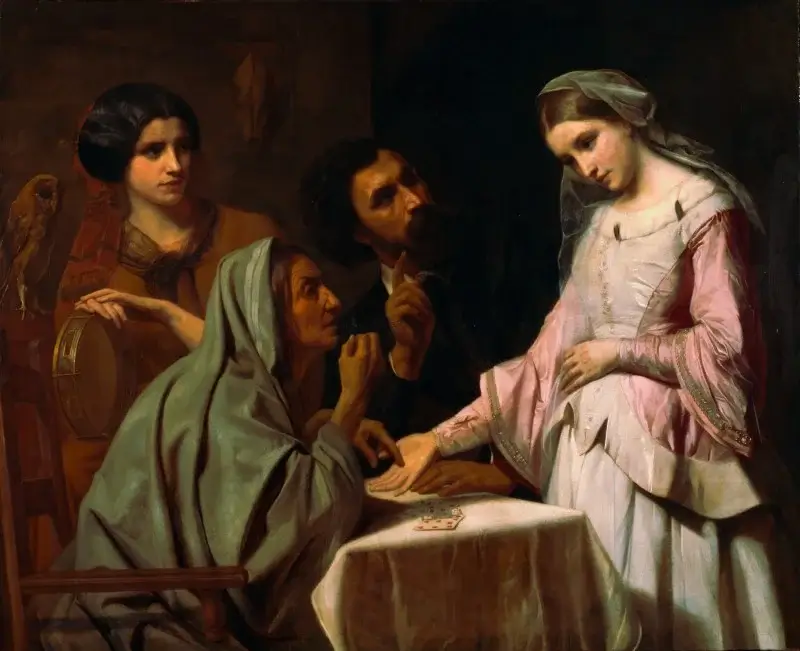
La cartomante, by Jules Jean-Baptiste Dehaussy. Image courtesy of Fondazione Cariplo via Wikimedia Commons. Licensed under CC BY-SA 3.0.
In Dehaussy’s La Cartomante, the cards on the table are not part of a game. They’re being read. A young woman extends her hand as an older figure studies it, while a small spread of cards lies nearby. Others lean in, watching closely, as if waiting for meaning to be revealed. There is no sense of competition, no exchange of turns. The tension comes from interpretation, what the older woman is to reveal, not from gameplay.
Before Solitaire became a recognizable game, it occupied a space between ritual and recreation, where cards were tools for reflection as much as entertainment. As these practices evolved into more structured forms of play, Solitaire moved out of this interpretive space and into the rhythms of everyday life, especially within the domestic interiors of the 19th century.
Solitaire Takes Shape in 19th-Century Life
By the late 19th century, Solitaire, then widely known as Patience, had become a recognizable and structured pastime. In art, it appears most clearly within a specific setting: the domestic interior, often centered on women.
2. Woman Playing Patience by Alexander Lauréus (1891)
Solitaire turned unstructured time into something ordered and controlled.

Woman Playing Patience, by Alexander Lauréus. Image via Wikimedia Commons. Public Domain.
In Woman Playing Patience, a young woman sits alone at a small table, illuminated by candlelight with a spread of cards in front of her, arranged in careful rows. There is no opponent, just the cards and quiet concentration. Here, Solitaire reflects a form of contained, domestic leisure, aligned with expectations placed on women: private, self-directed, and unobtrusive. But this is only one part of how the game is represented.
3. Kabalelæggeren by Caroline van Deurs (c. 1878–1932)
Solitaire became a way to tick through idle moments in time with deliberation and rhythm.
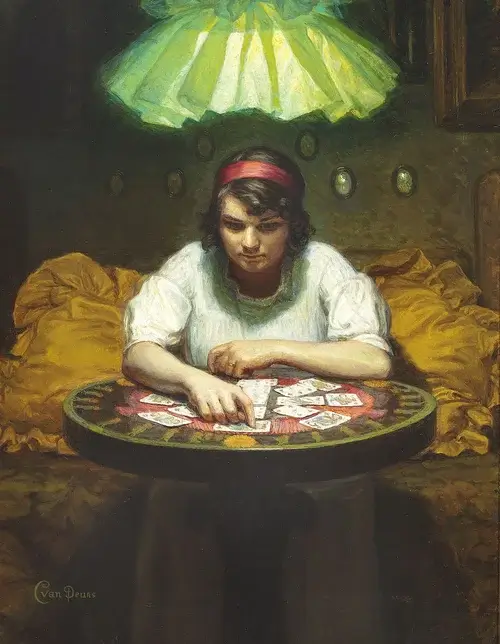
Kabalelæggeren, by Caroline van Deurs. Image via Wikimedia Commons. Public Domain.
In Kabalelæggeren, the arrangement of cards suggests a circular pattern, calling to mind the structure of a clockface. Whether intentional or not, the image introduces a subtle awareness of time, with each movement measured and sequential, as if echoing the steady, rhythmic movement of time.
Like the previous painting, the young woman’s focus is quiet and self-contained. There is no tension, no expectation of outcome. The continuous loop, rather than a clear beginning or end, feels repetitive in a purposeful way, with each move part of an ongoing cycle rather than a push toward completion.
4. The Three Patiences by Jehan-Georges Vibert (c. 1894)
What was once a quiet pastime becomes a visible use—and misuse—of time.
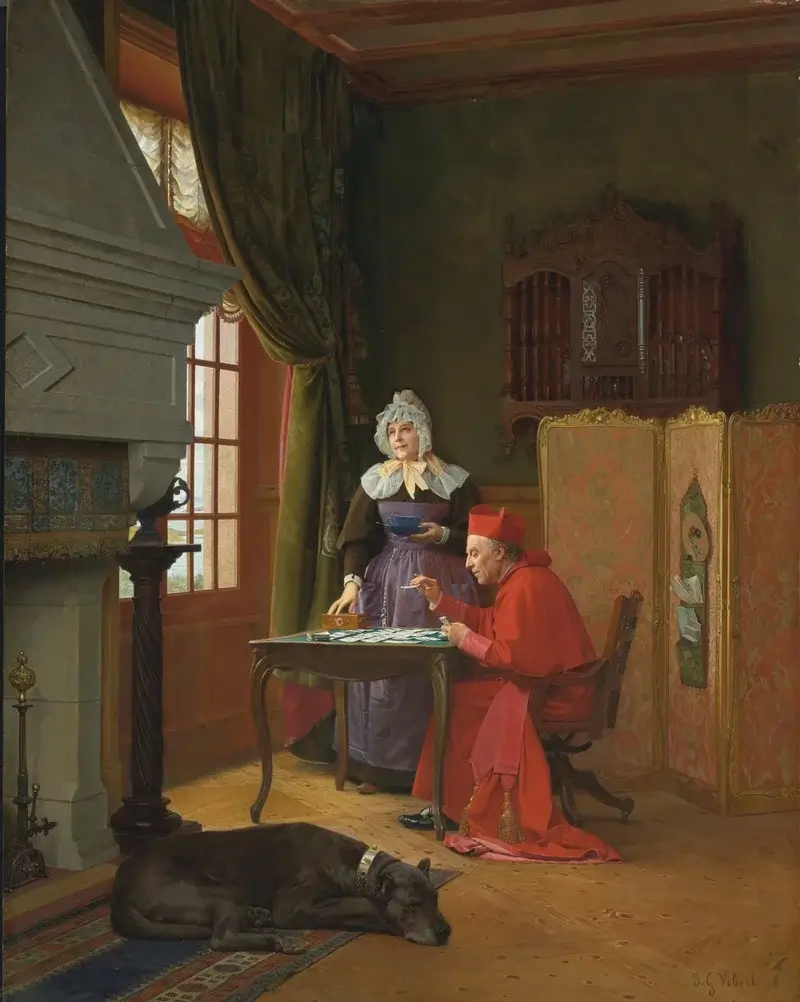
The Three Patiences, by Jehan-Georges Vibert. Image via Artvee. Public Domain.
Even in works that move beyond domestic interiors, the same pattern holds. In The Three Patiences, a cardinal sits absorbed in the game while two others, a woman and dog, wait patiently around him. Vibert was known for portraying members of the clergy in a satirical manner, in moments of trivial or indulgent leisure, but the commentary depends on recognition. Solitaire was common enough by this time to be used here to suggest distraction and delay, a quiet misuse of time within a setting that would otherwise have authority and purpose.
Taken together, these images suggest that in the 19th century, Solitaire was not defined by who played it, but by when it was played. It appears in moments of pause. Whether in domestic interiors, childhood scenes, or satirical commentary, the game consistently occupies a space between activity and idleness.
Rather than being associated with competition or skill, Solitaire became a way to structure otherwise unstructured time—ordered, quiet, and self-contained.
Solitaire Remains a Private, Feminine Space in the Early 20th Century
At the turn of the 20th century, Solitaire remains closely tied to the same quiet, interior spaces in which it had taken shape during the previous century. But in painting, it begins to appear with greater clarity and in more varied forms.
5. Portrait of Lady Eden by John Singer Sargent (1906)
Solitaire becomes part of how time—and the self—are composed.
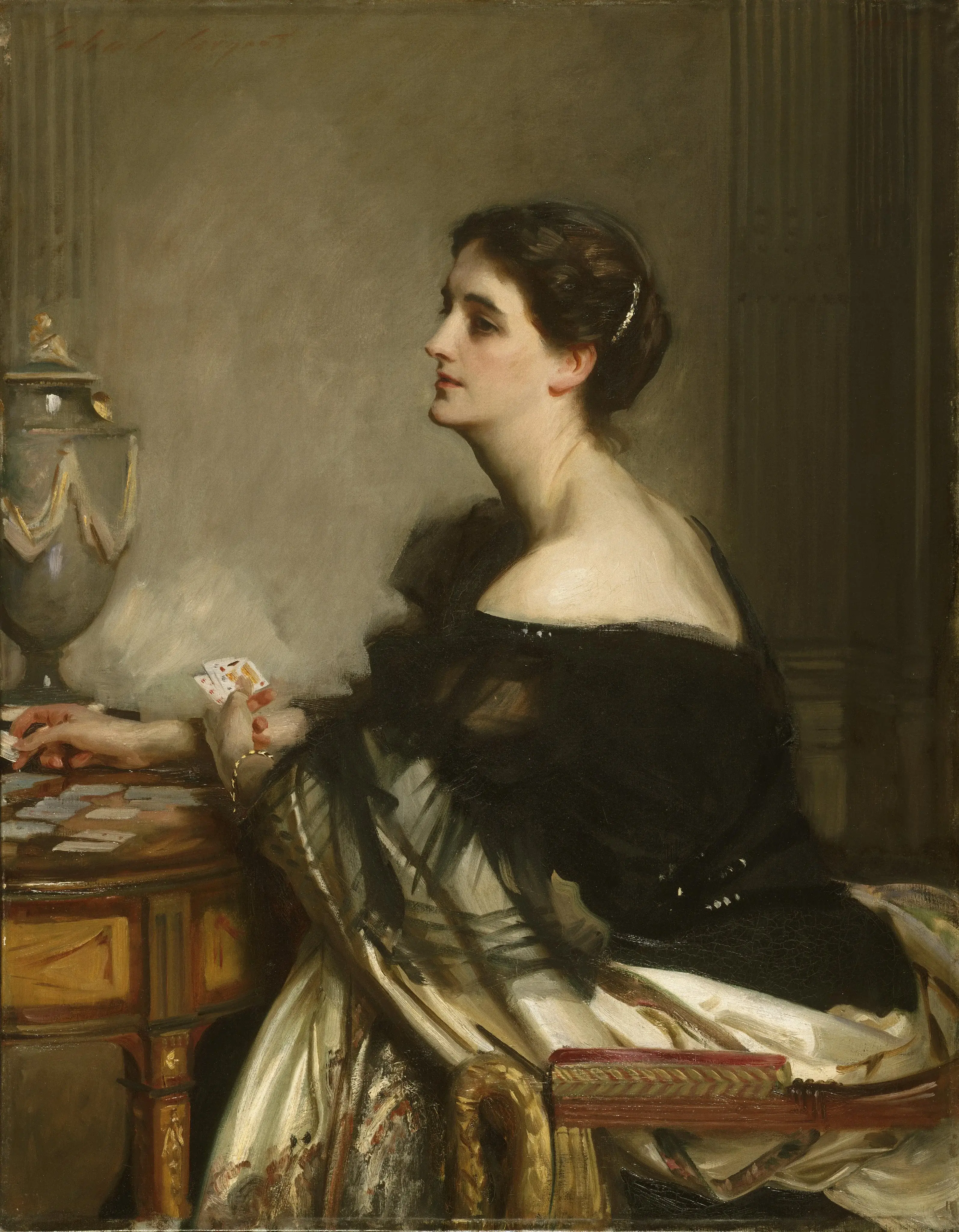
Portrait of Lady Eden, by John Singer Sargent. Image via Wikimedia Commons. Public Domain.
In Portrait of Lady Eden, a woman is depicted seated at a table with playing cards before her. Unlike earlier genre scenes, this is a formal portrait, composed with precision and restraint. The presence of the cards does not introduce drama or competition. Instead, it reinforces a sense of composure and inward attention. Solitaire becomes part of how the subject is represented, suggesting reflection, control, and a measured use of time.
6. Girl Playing Solitaire by Frank Weston Benson (1909)
Solitaire becomes a deliberate way to spend time, not just a default one.
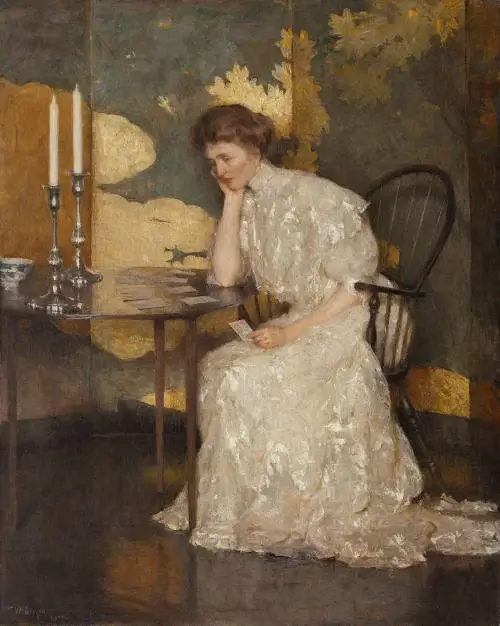
Girl Playing Solitaire, by Frank Weston Benson. Image via Wikimedia Commons. Public Domain.
A similar but more intimate moment appears in Girl Playing Solitaire, where a young woman sits alone, absorbed in the game. The setting is softer and less formal, but the core elements remain the same: stillness, concentration, and the absence of urgency. Solitaire is fully recognizable here, no longer ambiguous, but quietly embedded in everyday life.
Across both paintings, the meaning of the game is consistent. Solitaire remains associated with private, self-directed time, often within a domestic setting and still closely tied to women’s lives. It is not competitive or performative. Instead, it reflects a kind of contained autonomy, an activity that occupies time without demanding attention from others.
That sense of permanence extended beyond painting and into the material culture of the period. Specially designed patience tables, often lined with felt and built specifically for laying out cards, anchored the game physically within the home.
That connection between Solitaire and place as well as gendered roles would not last. As the 20th century progressed, particularly during the upheaval of the world wars, the game began to detach from the interiors that once defined it.
Solitaire in a Changing World
By the 1930s, Solitaire begins to appear in environments that are less defined by tradition and more shaped by circumstance.
7. La Patience by Georges Braque (1942)
In a fragmented world, Solitaire remains one of the few things that still follows a clear order.
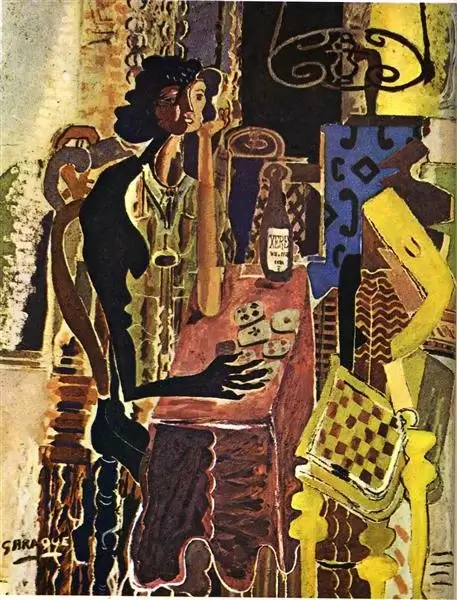
La Patience, by Georges Braque. Image via Wikiart Visual Art Encyclopedia. Fair Use.
That role becomes even more pronounced in La Patience. Created during World War II, this work of modern art reflects a world no longer experienced as stable or continuous. Unlike earlier depictions, the player recedes and elements of the game remain in a tightly constructed space. The Cubist perspective reshapes how the cards are seen. The composition isn’t a unified scene but overlapping planes that compress space and time.
While the world is experienced as layered, uncertain, and impacted by perspective, Solitaire is a structure that holds. Logic doesn’t shift, and the cards remain one of the few elements that aren’t fragmented. In this context, Solitaire is no longer simply a way to occupy time. In an environment shaped by uncertainty, the game provides a framework that holds, even when external conditions do not.
8. Solitaire by Norman Rockwell (c. 1950)
What began as a way to fill time becomes a way to claim it.
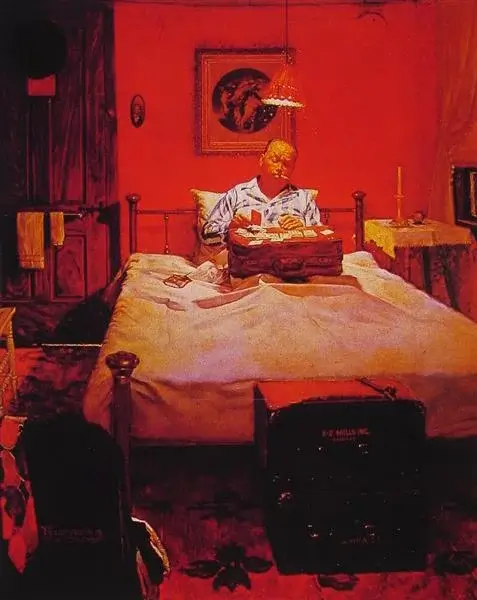
Solitaire, by Normal Rockwell. Image via Wikiart Visual Art Encyclopedia. Fair Use.
By the time Solitaire appears in mid-20th-century imagery, that function has fully transformed. In a well-known illustration of La Patience, a traveling salesman lies in bed, playing Solitaire on top of a briefcase. The setting is informal, even improvised. There is no designated table, no fixed environment, suggesting a life in motion rather than one anchored to a single place, like we see with 19th-century women.
The game is no longer tied to the domestic interior, to gendered expectations, or to idle moments shaped by circumstance. Instead, it moves with the individual. For men in the mid-20th century—particularly in the wake of the world wars, where card playing had become commonplace—Solitaire had become a familiar, portable activity, easily carried from one setting to the next.
What distinguishes this moment from earlier depictions is not just portability, but intention and ownership. Playing Solitaire is not a way to fill time that was assigned to him or a response to isolation imposed from outside. He is choosing to engage in the game. Solitaire, once rooted in place and expectation, has become fully personal—something that can be taken anywhere and played on one’s own terms.
Across these images, the meaning of Solitaire shifts in a clear progression. It begins as a way to ease solitude, becomes a way to structure time under pressure, and ultimately emerges as a fully personal activity, detached from place, expectation, or necessity.
From Paintings to Pixels
With Solitaire fully detached from place, the final shift is its transition into the digital world. When Solitaire appears on early personal computers decades later, it carries the same essential qualities seen across these paintings: solitary, self-directed, and structured.
Across this progression, Solitaire moves from something observed, to something lived, and finally to something integrated into everyday life. What began as a quiet activity captured in paint becomes a familiar presence in pixels on a screen. No longer confined to a particular setting, you can play for free anywhere, at any time on Solitaired.
About the author