Euchre Scoring Rules, Examples, and Strategies
By Neal Taparia - Published: 07/10/2026
A popular trick-taking card game, Euchre is played with four people paired off as partners, trying to reach 10 points first by winning tricks during each round. While the rules for Euchre scoring are straightforward, how you apply them depends on who made trump and how many tricks the team actually won. And because the trump and the person calling trump changes each round, your strategy for scoring must change as well.
Euchre can be an incredibly fast game because you only need to reach 10 points to win. So when you understand Euchre scoring rules, you not only capitalize better on opportunities to maximize your team’s score, you can win even faster. This guide helps you understand the details of Euchre scoring, the rules to apply, and even how to strategize so each round is an opportunity to score when you play Euchre.
Euchre Scoring Rules
The player who calls trump and their partner are known as the makers. Their goal is to win at least three of the five tricks during the hand. If they succeed, they score points. If they fail, they are euchred, and the opposing team scores instead.
Euchre Scoring Table
These are the points earned each round by situation:
| Situation | Points Awarded |
|---|---|
| Makers take 3 or 4 tricks | 1 point |
| Makers take 5 tricks | 2 points |
| Non-makers 3 or more tricks | 2 points (euchre) |
| Lone player wins 3 or 4 tricks | 1 point |
| Lone player wins 5 tricks | 4 points |
| Non-loner team wins 3 or more tricks | 2 points (euchre) |
| Player reneged in a non-loner round | 2 points for the opposing team |
| Player reneged in a loner round | 4 points for the opposing team |
Some house rules may include penalties for mis-deals (dealing incorrectly) or table talk (discussing or hinting about your hand to signal your partner), but in regular play, these actions result in the current round ending and a new deal beginning.
Euchre Scoring Checklist and Example
To score any hand, simply answer these questions:
- Who made the suit trump for that round (the makers)? Makers need to get the majority of tricks, so if you make trump, you put the risk on your team.
- How many tricks did the makers take as a team? If makers take the majority of tricks, they get either 1 point (for taking 3 or 4 tricks) or 2 points (taking all 5 tricks). But if they fail to get the majority of tricks, the other team earns 2 points, which is called a euchre. They get 2 points regardless of whether they won 3, 4, or 5 tricks.
- Did anyone go alone? If you call trump, you can also tell your partner not to play, which is called going alone. That means you are the only one playing for your team. A loner hand can score your team more points, but you still run the risk of being euchred.
- Did anyone not follow suit (called reneging)? If any player fails to follow suit and is caught, the opposing team is awarded 2 points. Although not following suit can happen by mistake, especially with beginners, it’s considered cheating and is penalized.
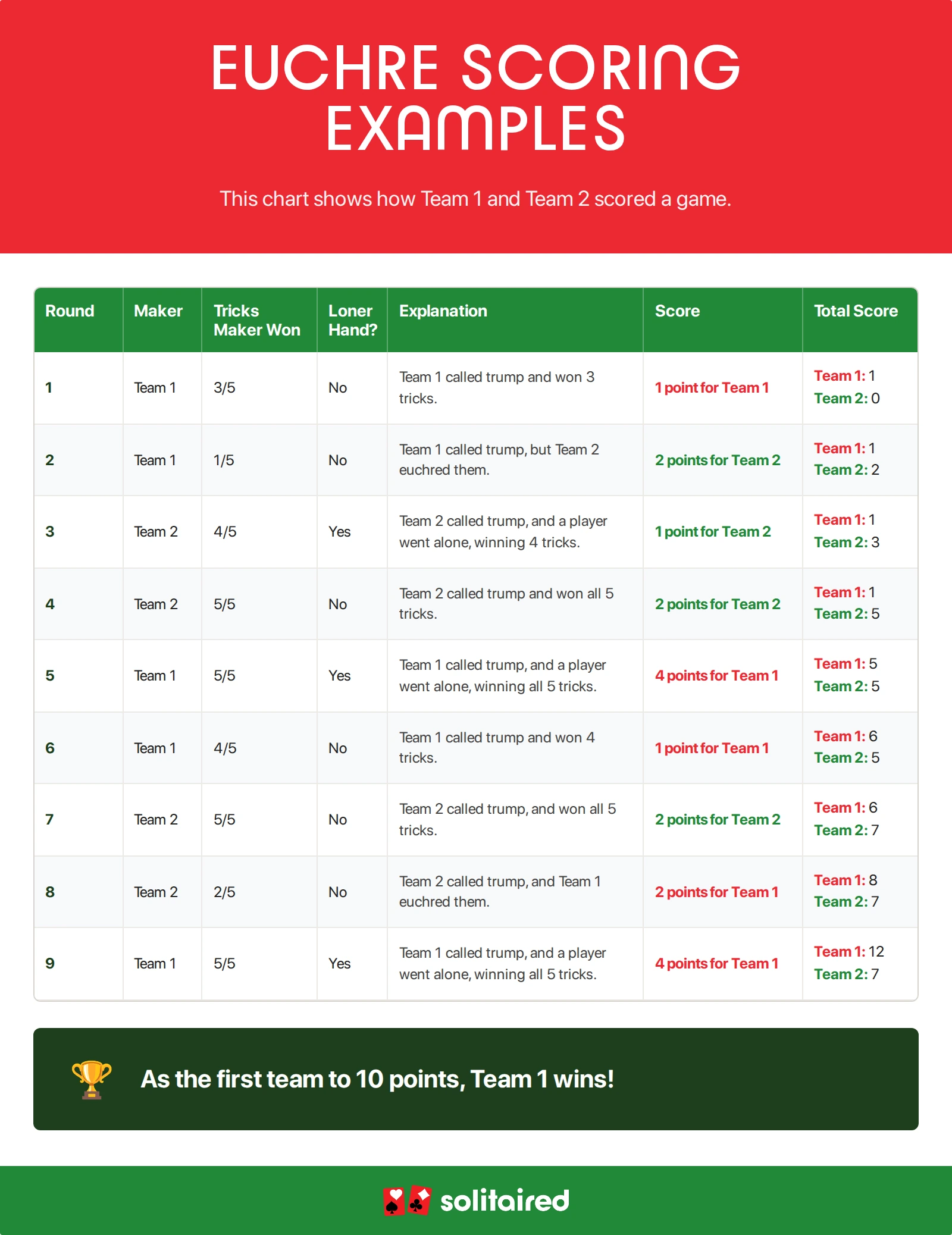
Once you have those answers, you can award points based on the criteria in the table above. For example
- Team 1 called trump and won 4 tricks: Because they’re the makers and they won 4 out of 5 tricks, they earn 1 point.
- Team 1 called trump and won 2 tricks: Because they’re the makers but only won 2 out of 5 tricks, Team 2 earns 2 points for euchring them.
- Team 2 called trump and one player went alone and won all 5 tricks: Because they’re the makers and a teammate went alone, they earn 4 points.
- Team 2 called trump and won all 5 tricks: Because they’re the makers and took all the tricks, they earn 2 points.
Keeping Score with 4 and 6 Cards
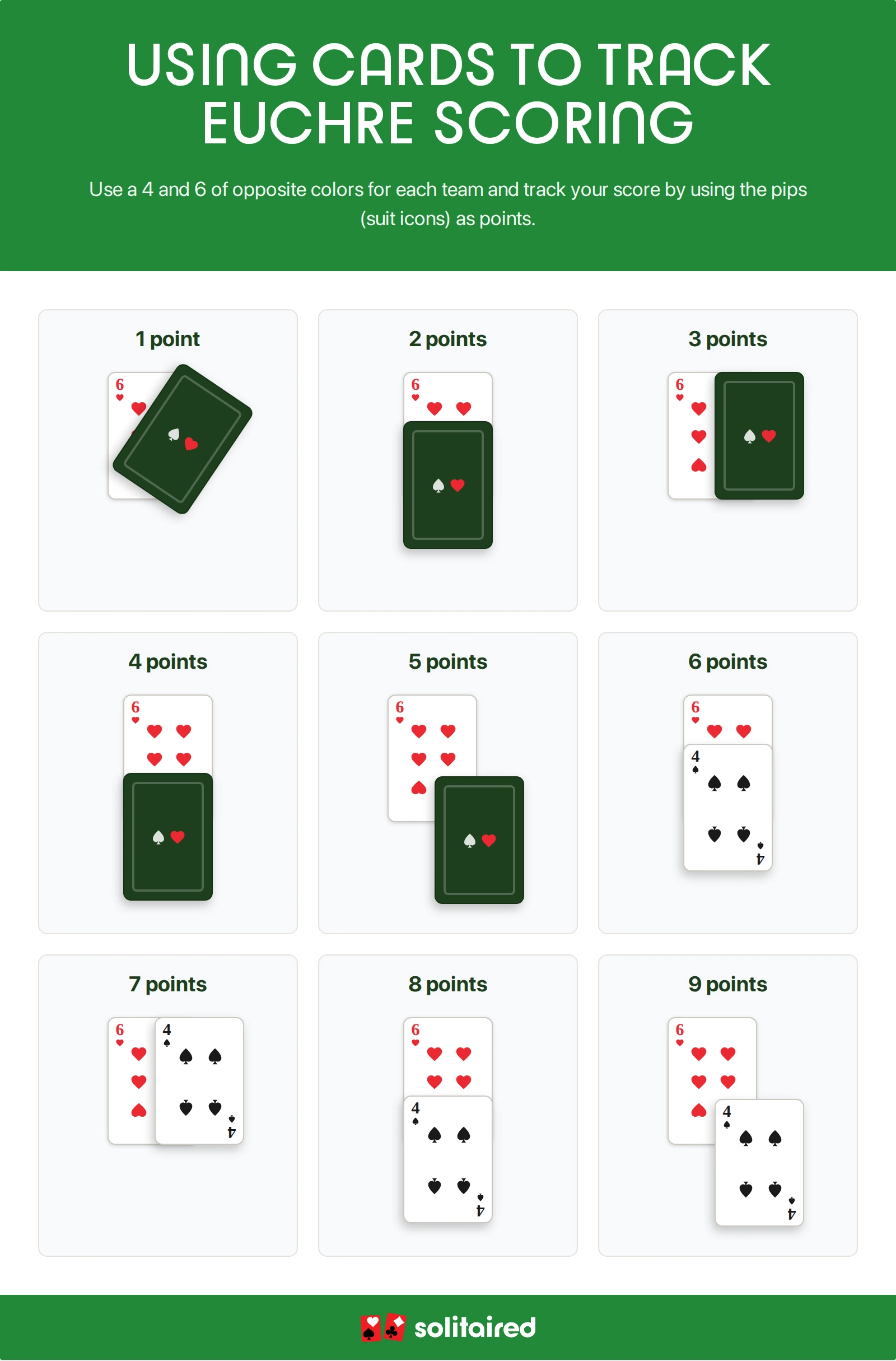
Because Euchre is only played with nines through aces, the most common way to keep score is for each team to simply use a 4 and 6 of any suit. You place one facedown over the other and reveal the card’s pips (suit icons) one at a time for each point. If you have the 4 facedown on the 6 and have exceeded 6 points, then you flip the 4 over and cover up or reveal the pips on the face-up 6 as you gain more points.
While tournaments and clubs may have different rules, the method for tracking the score is largely a house rule. However, if you wonder whether it matters which card covers the other first, some abide by this fun game tradition:
- 4 on 6 means lots of tricks!
- 6 on 4 means never score!
Using the cards adds a mental component to the game as well. Because the score is on obvious display, the losing team’s ability to handle stress is tested. They may take calculated risks, or they may make big mistakes. So you might hear a team say they’re “in the barn” or “at the bridge” when they reach 9 points, just to try and rattle the opposition.
How Trump and Card Rankings Affect Your Score
The game of Euchre is fast-paced, so every detail counts. And the better you understand certain rules, the better your chance of increasing your score. If you need to know more about the rules and setup, you can use our guide on how to play Euchre to fill in the gaps.
Calling and Using Trump
Calling trump plays an important role in the game. If your team makes trump, it gives you the upper hand because, presumably, you have more cards that are valuable to take tricks with. But you must choose carefully because not taking the majority of tricks gives the opposing team 2 points.
Remember these rules for trump so you can make an informed decision when calling or not calling trump:
- A trump suit is selected each round. Each round can have a different trump suit.
- Trump cards rank higher than any non-trump card.
- The highest ranking card wins the trick. The highest trump card wins the trick, or, if no trump was played, the highest ranking card of the lead suit wins the trick.
- Right bower: The jack of the trump suit is the highest ranking card for the round.
- Left bower: The jack of the same trump color is the second-highest ranking card for the round.
- The makers must win the majority of tricks to avoid being euchred. The team that makes trump are called the makers. Makers are at risk because if they don’t win the majority of tricks, the other team will earn points, but if they do take the majority of tricks, their team scores points.
Keeping Track of Changing Card Rank
Understanding card ranks in euchre helps you determine whether to pass or call trump, and helps you strategize your gameplay. With every hand, not only does the trump change but the cards that rank highest will also change.
Pay close attention to these card-rankings:
- The game is played with the 9 through ace of each suit. Euchre uses just 24 cards and doesn’t use any card ranked lower than 9.
- Aces are high and 9s are low for the non-trump suit.
- Some jacks rank higher, depending on trump. The jack of the trump suit and the jack of the same color of the trump suit are the two highest cards of the round. For example, if clubs are trump, then the jack of clubs is the highest card and the jack of spades is the second highest.
Following Suit
Following suit is an important rule, which, if broken, can give away points to the other team. So keep these rules in mind:
- Players must follow suit, if possible. Winners of the previous trick always lead the next trick. Going clockwise, each player must lay a card in the middle that is the same suit as the card led. If they don’t have a card of the same suit, they can play any card, including trump.
- Not following suit when you have the card ends the round. If you play a card when you should have followed suit and you’re caught, it’s called reneging. If a player reneges, the round ends and the other team receives 2 points (4 if it was a loner hand). However, you’re forced to follow suit on Solitaired, so you won’t make this mistake when you play online.
Scoring Strategies to Get to 10 Points Faster
With just 10 points determining the winner, strategy is extremely important to get to the finish line first. These strategies help you make the most of your hand to maximize your score.
Call Trump with Two Strong Trump Cards
While it’s not guaranteed, you can usually call trump if you have two high-ranking trump cards. For example, if you want to make hearts trump and you have the jack of hearts (right bower) and the ace of hearts, you should call trump. You can typically count on your partner to win one trick because partners tend to have one good off-suit card to take a non-trump trick. Because you only need three tricks to win, your two strong trump cards along with one from your partner should get you three tricks.
Lead Your Highest Trump If You Called Trump
When you call trump, you need at least three tricks to earn points. Because the other team could over trump you or play trump on one of your off-suit tricks, leading your highest trump card pulls out their trump cards because they have to follow suit. Although this also pulls out your partner’s trump, it most often cleans out the trump from the other team after two tricks, so you’re not surprised later.
Order Up Your Partner to Create a Cushion of Trump
On the first round of bidding, any player except the dealer can order up the dealer, requiring the dealer to pick up the turned-up card, discard one card, and make that card's suit trump. When your partner is the dealer, it’s a great opportunity to help your team pick up an extra trump card.
Of course, if you have a strong hand and want to make the top kitty card trump, do so, but sometimes your hand isn’t as strong, which makes it tough to decide. By ordering up your partner, you can give your team some breathing space when your hand is weaker. So if you have mid-ranking trump, such as the queen and king, ordering your partner can help buffer your team’s position. You want to be in control, if possible, of making trump to give your team the best chance of scoring.
Look to Euchre with a Weaker Hand
If your hand is slightly weaker to where you don’t think you can make trump and you or your partner can’t pick up the extra card because you aren’t dealing, consider how best to play your hand to euchre the other team. You can often play a low-ranking trump card when they lead trump to save your larger trump for other tricks. At the very least, you can likely stop them from getting all five tricks and scoring 2 points.
Go Alone If You Have a Strong Hand
If you have a decent hand for going alone, take the risk. If your hand is strong enough for a loner, you should win at least three tricks to earn 1 point. So while you’re risking losing one or two tricks without your partner’s help, the risk has huge rewards by earning your team 4 points. In a true loner hand, your partner is likely to contribute very little, and chances are good that if you lose one trick, you still would have lost it even if your partner was playing. So for a strong loner hand, you should always go for it. If nothing else, the more you try, the better you’ll be at determining whether you have a strong enough hand to go alone.
Reach 10 and Win with Solitaired
Playing Euchre is a great way to practice strategy, especially with partner-based trick-taking games, and the more you play, the better you get. So try out these strategies to score higher and more often while playing Euchre for free on Solitaired.
About the author