18 Games Like Solitaire: Card and Puzzle Games for Solo Play
By Neal Taparia - Published: 01/28/2026
Beyond classic Klondike, you can play many other card games that use a similar setup with a standard 52-card deck, as well as puzzle-style games that offer the same kind of solo, self-paced experience.
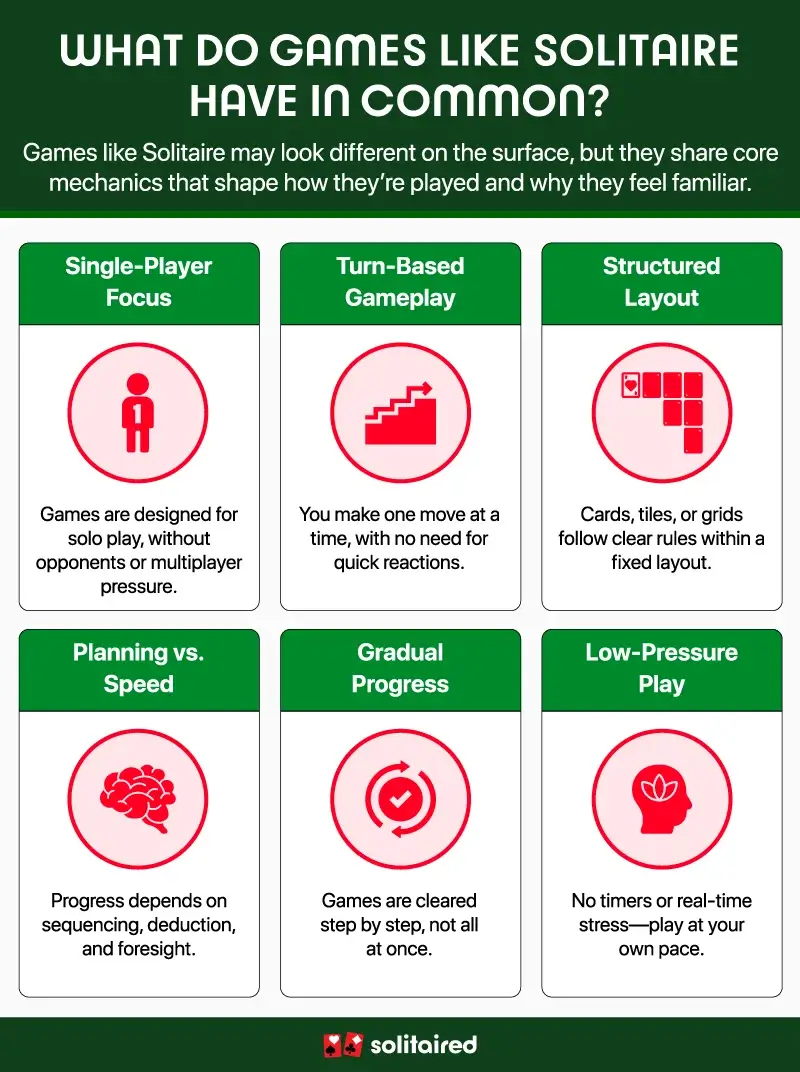
What makes these games feel like Classic Klondike Solitaire is the gameplay structure. Most involve organizing cards or tiles into sequences, working through a layout step by step, and making careful moves to uncover new options. Like Solitaire, they're designed for single-player play, don't require quick reactions, and reward planning and patience over speed.
Below, you'll find a curated list of games like Solitaire, including familiar Solitaire variants, other single-player card games, and a few puzzle games that capture the same logical, methodical feel. If you like to play Solitaire, you'll find plenty of options that offer a slightly different challenge, making it easy to try something new that fits how you like to play.
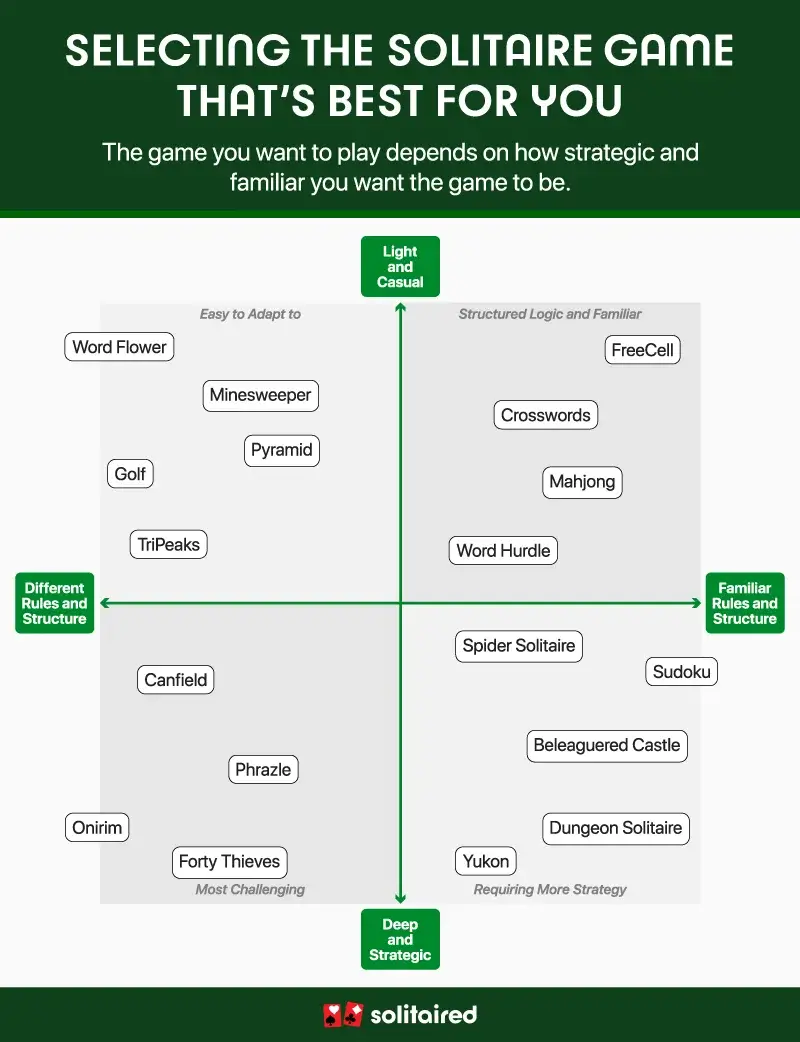
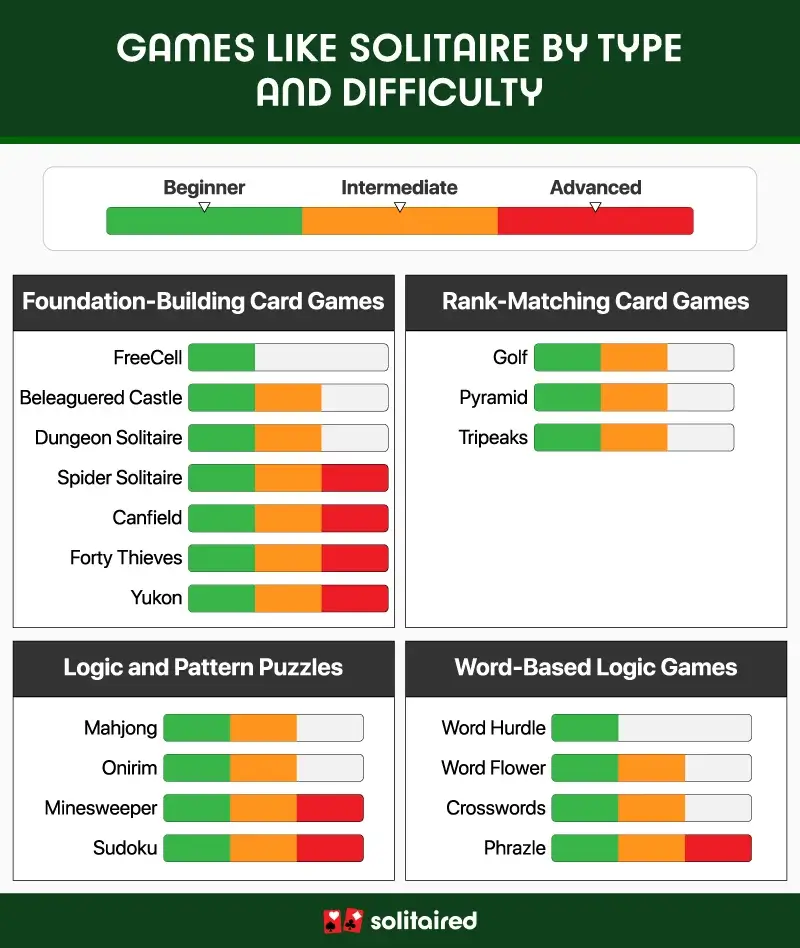
| Game | Category | Best for | Level | Core Gameplay Style |
|---|---|---|---|---|
| FreeCell | Classic variant | Strategic planners | Beginner | Open tableau + free cells |
| Yukon Solitaire | Classic variant | Creative tableau play | Intermediate | Flexible stack movement |
| Beleaguered Castle | Advanced variant | Methodical sequencing | Intermediate | Limited space + early foundations |
| Spider Solitaire | Advanced variant | Long, strategic sessions | Intermediate to Advanced | Multi-suit sequencing |
| Canfield Solitaire | Advanced variant | Unpredictable challenges | Advanced | Variable foundations + reserve |
| Forty Thieves | Advanced variant | Tight, skill-focused play | Advanced | Restricted tableau movement |
| Dungeon Solitaire | Solitaire-style variant | Structured progression and themed challenges | Intermediate | Layout clearing + progression-based play |
| Pyramid Solitaire | Matching or pairing | Logic-based pairing | Easy | Pair cards to reach 13 |
| Golf Solitaire | Matching or pairing | Fast, casual rounds | Intermediate | Rank matching to waste pile |
| TriPeaks Solitaire | Matching or pairing | Flow-based play | Intermediate | Sequential rank clearing |
| Sudoku | Puzzle-style | Logical deduction | Beginner to Advanced | Number placement logic |
| Mahjong Solitaire | Puzzle-style | Visual pattern recognition | Intermediate | Tile matching |
| Onirim | Puzzle-style | Constrained, logic-driven card puzzles | Intermediate | Hand management + symbolic sequencing |
| Minesweeper | Puzzle-style | Deduction under constraints | Intermediate to Advanced | Risk-based grid logic |
| Word Hurdle | Word game | Quick word challenges | Beginner | Letter deduction |
| Word Flower | Word game | Exploratory word building | Beginner to Intermediate | Freeform word creation |
| Crossword | Word game | Thoughtful wordplay | Intermediate | Clue-based grid solving |
| Phrazle | Word game | Phrase-level deduction | Advanced | Multiword logic |
Card Games Like Solitaire: Classic Variants
Klondike is the version most people picture when they think of Solitaire. It uses a familiar layout with seven tableau piles, hidden cards that are gradually revealed, and the objective of building four foundation piles by suit from ace to king.
If you like the traditional tableau-and-foundation setup of Classic Solitaire, these games will feel instantly familiar. They use the same core setup—a standard deck of playing cards (or two), tableau piles, and foundation piles—but tweak the rules just enough to change the challenge while keeping the familiar feel.
1. FreeCell
- Best for: Players who enjoy thoughtful planning with minimal luck
- Level: Beginner
- Objective: Organize all cards into foundation piles by suit in ascending order
FreeCell Solitaire is easier than the classic version because it removes much of the randomness. The entire deck of cards is dealt into the tableau, and the columns have no facedown cards, which means you have no hidden cards to reveal—everything you need to win is visible from the beginning. This shifts the focus away from chance and toward deliberate strategy, making FreeCell a satisfying choice for players who like to think several moves ahead.
How to play:
You build the tableau in descending order with alternating colors, similar to classic Solitaire. Four free cells act as temporary storage spaces that let you reposition cards strategically as you work to fill each foundation from ace to king. Because the entire layout is visible, success depends on making the right sequences and using the free cells wisely.
2. Yukon Solitaire
- Best for: Players who enjoy creative tableau play with more freedom
- Level: Intermediate
- Objective: Move all cards into the foundation piles by suit, building from ace upward
Yukon Solitaire looks a lot like regular Solitaire at first glance, but it loosens some of the restrictions you may be used to. However, that doesn't make this version easier.
In Yukon, you can move groups of cards even when they aren't perfectly ordered, which opens up more options and encourages more creative problem-solving, but it also means the game is more difficult. Moving cards that are unsequenced can layer cards in a way that blocks future moves, and with no stockpile to rely on, you can get stuck quickly.
How to play:
Cards are arranged into tableau piles, and you build them in descending order while alternating colors. Unlike other Solitaire variants, you can drag entire stacks as long as the bottom card of the group fits the destination spot. Work through the tableau, uncovering face-down cards and feeding opportunities into the foundation piles to clear the deck.
3. Beleaguered Castle
- Best for: Players who enjoy methodical sequencing and careful planning
- Level: Intermediate
- Objective: Move all cards into foundation piles by suit in ascending order
Beleaguered Castle starts with all four aces already in their foundation piles, which immediately gives you a headstart, but the lack of a stockpile and no free spaces makes movement a challenge. You must manage the constrained tableau, making every choice about where to play a card meaningful. If you enjoy carefully optimizing sequences and watching options open up one move at a time, this game delivers a challenging strategic experience.
How to play:
Cards are laid out into eight face-up tableau piles, and foundation piles begin with the four aces already exposed. You build the tableau in descending order, alternating colors, and build foundations by suit from ace upward. Success depends on uncovering new cards and preserving flexibility in the tableau as you work through the layout.
4. Spider Solitaire
- Best for: Players who want a strategic Solitaire challenge with opportunities for added complexity
- Level: Intermediate to Advanced
- Objective: Complete eight sequences by suit and clear them from the tableau
Spider Solitaire uses 104 playing cards and lets you choose how many suits to include (1 Suit, 2 Suits, or 4 Suits), which directly affects how hard the game feels. With one suit, the moves are more predictable and approachable, but as you move up to two or four suits, the difficulty increases. This design makes Spider great for players who like thoughtful sessions that demand careful planning.
How to play:
Cards are laid out across multiple tableau piles, and you build them in descending order regardless of suit, although only sequences built from cards of the same suit can be moved as a unit. To remove cards from play, you need to complete full sequences from king down to ace in the same suit. Completed sequences are cleared, opening up more play space. But if you get stuck, using the stockpile causes one face-up card to be dealt to the bottom of each column.
5. Canfield Solitaire
- Best for: Players who like variation and a bit of unpredictability
- Level: Advanced
- Objective: Move all cards to foundation piles by suit, starting from a random base card
Canfield Solitaire shakes up the classic Solitaire setup by requiring the foundations to start from a randomly selected base card rather than always starting at ace. This version also adds a reserve pile of 13 facedown cards in addition to the stockpile, and with a limited tableau of only four columns, movement is quite restricted. These constraints make Canfield a more difficult Solitaire card game, but they also give you a varied challenge with each new game.
How to play:
Cards are arranged into four tableau piles where you build in descending order with alternating colors, similar to Classic Solitaire. The foundations start from a base card that isn't always an ace, and you work to build up each suit from that point. Success comes from uncovering tableau cards, managing space, and finding ways to feed the foundations in the most efficient order.
6. Forty Thieves
- Best for: Players who want a tighter, more strategic Solitaire challenge
- Level: Advanced
- Objective: Build all cards into the foundation piles by suit, starting from ace upward
Forty Thieves is a demanding game of Solitaire because it gives you less flexibility in the tableau. With two decks and tighter movement options, every play matters, and planning ahead is essential. If you enjoy thoughtful sequencing and slower-paced games where each card placement has weight, this is a satisfying step beyond classic Klondike.
How to play:
Cards are dealt into ten tableau piles with only four cards each. Because you build sequences in descending order by suit, there are fewer opportunities for easy moves. Feed cards up to the foundation piles in ascending suit order whenever possible. Since empty tableau spaces aren't always easy to create, success depends on careful sequencing and patience with each play.
7. Dungeon Solitaire
- Best for: Players who enjoy classic Solitaire with a themed progression system
- Level: Intermediate
- Objective: Clear card layouts to advance through dungeon levels and encounters
Dungeon Solitaire takes familiar Solitaire mechanics and layers them into a fantasy-themed progression. While the core gameplay revolves around clearing card layouts, added elements like enemies, items, and level structure introduce a sense of advancement beyond a single hand. It appeals to players who enjoy Solitaire but want a more gamer-like arc.
How to play:
You play through a series of card layouts, removing cards according to the game's sequencing rules. Clearing cards allows you to progress through dungeon stages, while special cards and effects influence how each level unfolds. The goal is to complete each layout efficiently to move forward.
Solitaire-Style Card Games That Use Matching or Pairing
These games feel like Solitaire, but they remove foundation building. Instead of organizing cards into suits, you focus on clearing layouts by matching ranks in ascending or descending order or pairing cards. The result is a quicker, more fluid experience that still rewards planning and pattern recognition, making these games a good fit if you enjoy Solitaire's logic but want something simpler in terms of gameplay and rules.
8. Pyramid Solitaire
- Best for: Players who enjoy pairing instead sequencing cards
- Level: Easy
- Objective: Remove all cards by pairing any that add up to 13
Pyramid Solitaire turns the card layout itself into the core challenge. Cards are arranged in a triangular pyramid, and only cards that aren't covered by others are playable. Instead of building long sequences, the game is about spotting and removing pairs that add up to 13 (although kings can be moved solo), making each decision feel like a small logic puzzle.
How to play:
Cards are laid out in a pyramid formation with overlapping rows, and only cards that are fully exposed can be paired. To remove cards, you select pairs whose values add up to 13, gradually dismantling the pyramid until either all cards are cleared or no more legal pairs remain. You can use the stockpile for a new card to pair with if you run out of moves on the tableau, and you can cycle through the stock three times.
9. Golf Solitaire
- Best for: Players who want a straightforward rank-matching game
- Level: Intermediate
- Objective: Clear all tableau cards by pairing ranks one lower or higher with the waste pile card
Golf Solitaire simplifies the Solitaire experience into a matching-style game. You have no foundation piles to build; instead, the game focuses on removing cards from the tableau by matching them to the top card of the waste pile. Because rounds are quick and easy to understand, Golf is perfect for quick, casual play.
How to play:
Cards are dealt into seven face-up tableau rows with a facedown stockpile. You remove cards by playing cards that are one rank higher or lower than the top card of the waste pile, regardless of suit. Use the stockpile when you get stuck to turn over a fresh card into the waste pile. Continue working through the tableau with valid moves until all cards are cleared or you run out of moves and stockpile cards.
10. TriPeaks Solitaire
- Best for: Players who want a blend of Golf and Pyramid
- Level: Intermediate
- Objective: Clear all tableau cards by pairing ranks one lower or higher with the waste pile card
TriPeaks Solitaire takes the familiar feel of classic Solitaire and streamlines it into a faster, more accessible format. Instead of managing multiple tableau stacks and foundations, you focus on clearing cards by matching sequences. This makes TriPeaks ideal for short sessions when you want the satisfaction of a good run without a long commitment.
How to play:
Cards are laid out in three overlapping peaks. You remove tableau cards by playing cards that are one rank higher or lower than the top card of the stock pile, creating a chain of moves whenever possible. The goal is to clear all peaks before running out of eligible plays.
Puzzle-Style Games
Many players who enjoy Solitaire's calm, self-paced rhythm also like puzzle games that don't use playing cards but offer a similar feel: uncovering hidden information, spotting patterns, and making thoughtful decisions. The games below deliver that familiar sense of progress without opponents or time pressure.
11. Sudoku
- Best for: Logical thinkers who enjoy structured problem-solving
- Level: Beginner to Advanced
- Objective: Complete the grid so each row, column, and box contains numbers 1–9 exactly once
Sudoku offers the same kind of focus that draws people to Solitaire. Progress comes from strategizing, careful deduction, and eliminating possibilities, one move at a time.
How to play:
You're given a partially filled grid and use logic to determine where each missing number belongs. Correct placements open up new deductions, gradually guiding you toward a complete solution.
12. Mahjong Solitaire
- Best for: Players who enjoy visual pattern recognition
- Level: Intermediate
- Objective: Clear the board by removing matching pairs of open tiles
Mahjong Solitaire replaces cards with a layered set of tiles. It keeps the solo, puzzle-oriented feel of Solitaire by having you scan for open tiles and clear them by pairing them with like tiles. Because only uncovered tiles can be matched, each choice affects your future options.
How to play:
Tiles are laid out in a stacked, overlapping pattern of your choice. You remove matching pairs of tiles that are free on their left or right side, gradually clearing the board as you uncover new matches.
13. Onirim
- Best for: Players who enjoy atmospheric, puzzle-driven solo play
- Level: Intermediate
- Objective: Escape the dream world by finding all required doors before the deck runs out
Onirim blends Solitaire-style card play with a strong puzzle element. While it doesn't use traditional tableau building, it captures the same feeling of working within tight constraints and planning several moves ahead. Each decision affects future possibilities, and the game balances careful sequencing with an element of risk.
How to play:
You draw and play cards from a shared deck, building paths by matching symbols and colors. Certain cards trigger special effects, while others must be discarded strategically. To win, you need to reveal and collect a set number of door cards before the deck is exhausted.
14. Minesweeper
- Best for: Players who enjoy deduction under constraints
- Level: Intermediate to Advanced
- Objective: Clear a grid without tripping mines, using numerical clues
Minesweeper may look very different from Solitaire, but the core experience—interpreting limited information to make the best next move—feels familiar. It's a solo logic game that rewards careful thinking rather than speed.
How to play:
You uncover squares on a grid. Numbers indicate how many adjacent squares contain hidden mines. Use these clues to safely open all non-mine squares without guessing.
Word Games for Solo Play
While word games don't use cards or visual layouts, many solo players who enjoy Solitaire also like word-based games for the same reason: They're self-paced and focused on individual problem-solving and pattern recognition. These games use vocabulary, deduction, and logic, offering a different—but equally satisfying—solo experience.
15. Word Hurdle
- Best for: Casual players who enjoy short, repeatable challenges
- Level: Beginner
- Objective: Guess a hidden word within a limited number of attempts
Word Hurdle offers a quick, contained puzzle that's easy to pick up and play. Like Solitaire, each round is self-contained and relies on learning from previous moves. The appeal comes from refining guesses and narrowing down possibilities rather than racing against a clock.
How to play:
You enter word guesses and receive visual feedback showing which letters are correct or misplaced. Using that feedback, you adjust your next guess until the word is solved or attempts run out.
16. WordFlower
- Best for: Players who enjoy discovery and flexible word building
- Level: Beginner to Intermediate
- Objective: Make as many valid words as possible by connecting letters
WordFlower blends pattern recognition with freeform word creation in a way that feels relaxing and engaging. Unlike strict guessing games, this one lets you explore possibilities at your own pace and uncover new word pathways as you play. It's ideal for players who like the gradual "aha" moments you get in Solitaire when a move opens up new options.
How to play:
You're given a set of letters arranged like petals on a flower. Create valid words by selecting connected letters, with each correct word contributing to your score. There's no timer or opponent pressure—just steady, self-paced word exploration.
17. Crossword
- Best for: Players who prefer slower, thoughtful wordplay
- Level: Intermediate
- Objective: Complete a grid using written clues
Crossword puzzles offer a steady, methodical experience that mirrors Solitaire's pace. There's no randomness once the puzzle begins, and progress comes from working through clues logically and building on partial answers.
How to play:
You fill in a crossword grid by answering clues that correspond to each row and column. Solving one word often helps unlock others, creating a gradual sense of forward momentum.
18. Phrazle
- Best for: Players who enjoy layered deduction
- Level: Advanced
- Objective: Solve a hidden multiword phrase using logic and feedback
Phrazle builds on familiar word-guessing mechanics but adds complexity by using full phrases instead of single words. This creates a deeper puzzle where progress depends on understanding structure, spacing, and letter placement across multiple words.
How to play:
You guess entire phrases and receive color-coded feedback for each letter. Over several attempts, you refine your guesses until the full phrase is revealed.
Find a New Favorite on Solitaired
Whether you prefer the familiarity of Classic Solitaire, the added challenge of its many variations, or the calm logic of puzzle and word games, you'll find no shortage of solo games that reward patience and thoughtful play. What these games share is a self-paced experience—no opponents, no pressure, just the satisfaction of working through a problem one move at a time.
Discover these Solitaire games and more on Solitaired where you can play new and old favorites for free with no apps or required downloads!
About the author