How to Play Fourpeaks Solitaire
Fourpeaks Solitaire was designed by the Solitaired team after seeing how much our users loved Tripeaks. Unlike the traditional Klondike Solitaire, you don’t arrange cards into the foundation piles. Instead, similar to Tripeaks, you pair cards from the tableau that are one rank higher or lower than the top card on the waste pile, similar to Golf Solitaire.
Objective
Clear the tableau by pairing the top card of the waste pile with a tableau card that is one rank higher or lower. Suit and color do not matter, so you can match cards of the same or different colors.
Fourpeaks Solitaire Setup
Fourpeaks Solitaire has three basic piles or that you use to play the game:
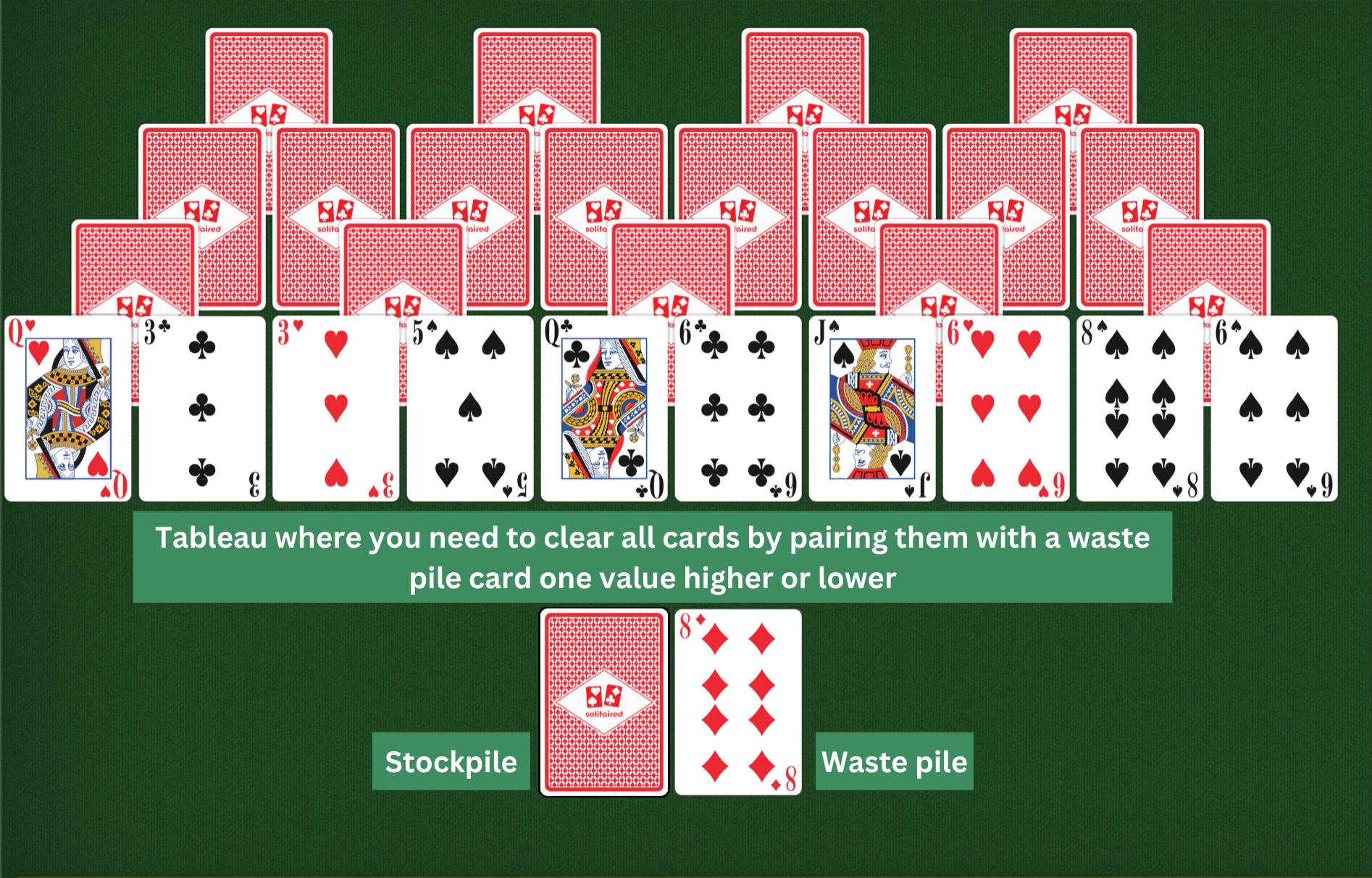
- The tableau: The main area of play and uses 27 cards. Set up like four mountain ranges, the first three rows of facedown cards overlap cards in the previous row. The fourth and last row of the four peaks is a shared row of 10 face-up cards. You must clear the entire tableau, not the stockpile, to win the game.
- The stockpile: 24 cards are placed facedown in a pile at the bottom of the tableau. You flip cards over into the stockpile one card at a time. You can only pass through the stockpile once during the game.
- The waste pile: The first card you flip from the stockpile becomes your first face-up waste pile card. You pair a card from the tableau with this waste pile card that is one rank higher or lower. When you pair a card from the tableau, the tableau cards become the new top card of the waste pile, the one that needs to be paired next. If you run out of moves, you can turn over another card from the stockpile and use it for pairing.
Fourpeaks Solitaire Rules
The rules are similar to Tripeaks:
- You can only pair the top waste pile card with tableau cards that are one rank higher or lower. For example, if a 9 of diamonds is the top card of the waste pile, you can pair it with either a 10 of any suit or a 8 of any suit in the tableau. The tableau card you pair then becomes the top card of the waste pile.
- You can only use cards that are available and face-up. Not all the cards are face-up or available for play. Available cards are not overlapped by other cards, and available cards, once revealed, can be turned face-up and be played.
- You can only go through the stockpile once. Not every waste pile card results in a pairing. If you can’t pair the top card from the waste pile with a card on the tableau, you can flip over the next stockpile card to reveal a new waste pile card. However, you can only cycle through the stockpile once or else the game is over.
- You cannot build sequences. Unlike Klondike Solitaire, this game doesn’t involve building sequences in the tableau or in foundation piles. The only moves you can make are pairing cards from the tableau with waste pile cards.
- You cannot fill empty spaces. Although you may want to save a card from the waste pile to use later, you can’t backfill gaps left behind after you pair cards. You have to play the tableau as it’s dealt without moving or storing cards.
Strategies to Win Fourpeaks
Fourpeaks may seem straightforward at first, but clearing the tableau can be tricky, especially since not all cards are visible. These strategies can help improve your chances of winning:
- Use the stockpile sparingly. You only get to cycle through the 24-card stockpile once, so passing up a crucial card can make a difference. Since you can’t see the rank of the cards in the tableau until they become available, try to make turning over a new stockpile card a last resort.
- Plan your moves. Although you can only plan your moves with the cards that are currently revealed, work to pair the longest sequences you can so you remove as many cards in one move as possible.
- Pause your moves when new cards are revealed. Even if you have planned a strong pairing sequence, a newly revealed card can change your options. Take a moment to see if it can help extend your sequence before continuing with your original plan.
- Remove cards as evenly as possible. Like Pyramid, avoid focusing on just one area of the tableau. Work across all four peaks to reveal more cards and increase your available moves.
- Remember that you can move up and down in rank. Building long sequences depends on moving in both directions. For example, if you match the 4 of spades in the waste pile with a 5 of hearts in the tableau, the 5 becomes the new waste pile card. You can then move backward by matching a 4 of hearts, or forward again by matching it with a 6 of clubs.
- Reveal as many new cards as you can. If you must choose between uncovering one card or two, always go with the option that reveals more cards. This gives you better chances of finding playable moves.
- Use the hint button. The hint feature can help you spot possible moves, and the undo button lets you experiment with different strategies.
If you like Fourpeaks Solitaire, you can try some variations that have a similar goal of matching and pairing to clear the tableau:
- Diamond Solitaire is a pairing game like Fourpeaks, but shaped like a diamond.
- Hole in One Solitaire is another pairing game, but with one card facedown in the tableau.
- Five Bridges is like Fourpeaks, but with a tableau shaped like bridges.
- Golf Solitaire follows the same rank pairing as Tripeaks, but its seven-column layout makes it more challenging.
- Pyramid Solitaire requires you to clear the single-pyramid tableau by pairing available cards that add up to 13.
