Gin Rummy Scoring: Rules, Examples & Strategies
By Neal Taparia - Published: 09/17/2026
Gin Rummy is a two-player card game where you try to reach 100 points before your opponent by forming melds and minimizing your deadwood, or unmatched cards. While forming sets and runs helps lower your deadwood, how you end each hand determines how many points you actually score. You can knock when you have 10 points or less in deadwood (point value of the non-meld cards left in your hand), go gin when you have no deadwood, or even score when your opponent knocks and you can undercut them (have less deadwood than they do).
Understanding Gin Rummy scoring, including the gin bonus and undercut bonus, can help you decide whether to knock or keep playing for a potentially higher score. This guide explains Gin Rummy scoring rules, walks through scoring examples, and shows you how to use scoring to make more strategic decisions as you work toward 100 points whenever you play Gin Rummy online.
Gin Rummy Scoring Rules
After each hand, only the winning player scores points. Play continues until one player reaches 100 or more points, at which point end-of-game bonuses are added. These rules walk you through how scoring in gin rummy works.
Use this table as a quick reference for how points are awarded during each hand and which bonuses are added after a player reaches 100 points.
| Situation | Points Awarded |
|---|---|
| A player knocks with less deadwood than their opponent. | The player who knocked receives points equal to the difference between their deadwood and the opponent’s deadwood. |
| The opponent undercuts the player who knocked. | The opponent receives difference in deadwood + 25-point undercut bonus |
| The deadwood totals tie after a knock. | The opponent receives 25 points. |
| A player goes gin. | The player receives points equal to the opponent's deadwood + a 25-point gin bonus. |
| Bonuses Added to the Winner’s Total After the Game Is Over | |
| Game bonus | 100 points |
| Hand bonus | 25 points for each hand won |
| Shutout bonus | Double the total hand score if all hands were won |
Calculate the Value of Your Deadwood
You need 10 points or less in deadwood to knock, which ends the hand. Deadwood includes any cards in your hand that aren't part of a meld. Melds are either sets of three or four cards of the same rank or runs of three or more cards of the same suit in sequence.
Calculate the value of your deadwood based on the cards left unmatched:
- Aces: 1 point each
- Number cards: Face value, so a 4 is worth 4 points and a 9 is worth 9 points
- Face cards: 10 points each
For example, if your unmatched cards are A♣, 4♦, you have 5 deadwood points (1 + 4).
Score the Difference in Deadwood
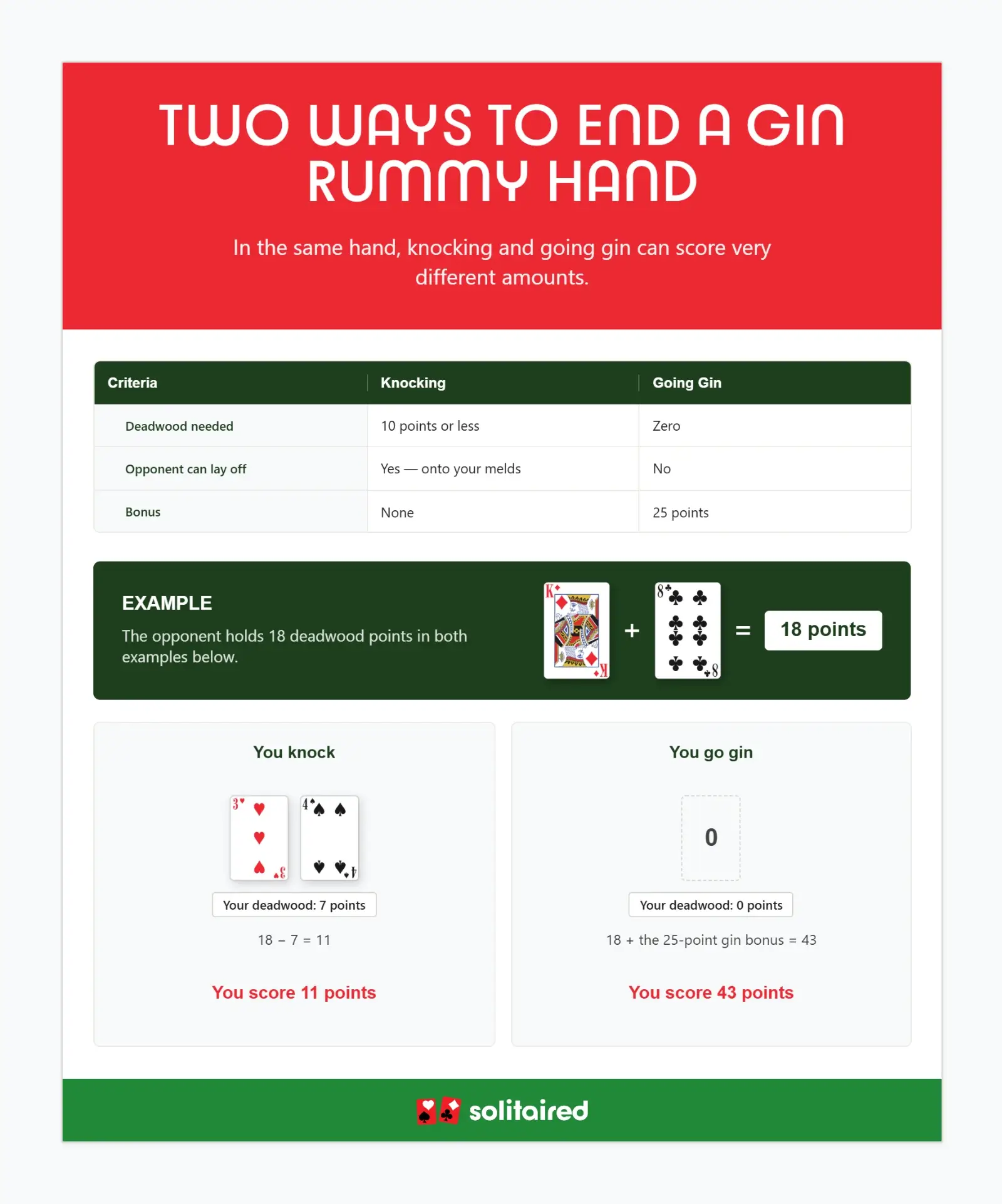
When you end the hand with less deadwood than your opponent, the difference between your deadwood totals forms the base score for the hand. This applies whether you knock or go gin.
- If you knock with 10 points or less in deadwood, your opponent can first lay off unmatched cards onto your melds.
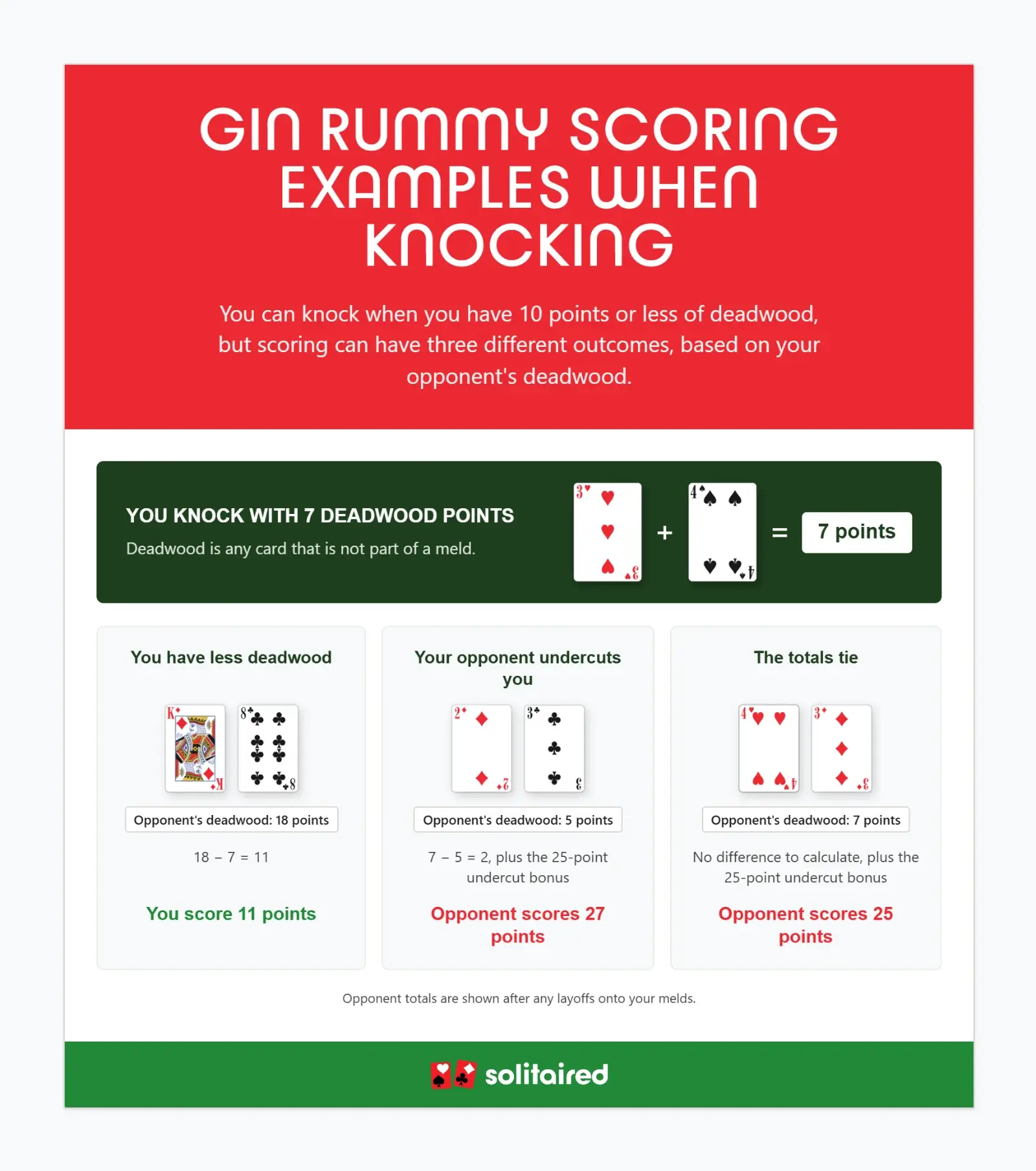
- If you still have less deadwood after any layoffs, subtract your deadwood from your opponent's to calculate your score. For example, if you knock with 7 deadwood points and your opponent has 18 after laying off, you score 11 points (18 - 7).
- If your opponent has less deadwood after any layoffs, your opponent will score the deadwood difference in what is called an undercut. For example, if you knock with 7 deadwood points and your opponent has just 5 after laying off, your opponent scores 2 points (7 - 5). They also receive an undercut bonus (25 points), which is explained below.
- If there is a tie in deadwood, there is no deadwood difference to calculate, but your opponent would receive the undercut bonus (25 points).
- If you go gin, you have zero deadwood, so the difference is simply the full value of your opponent's deadwood. Your opponent can't lay off cards when you go gin. So if you go gin and your opponent has 18 deadwood points, the difference is the value of their deadwood (18 points). You then add the gin bonus (25 points), which is explained below.
Add Hand Bonuses, if Applicable
Depending on how the hand ends, you may need to add one of the following bonuses to the difference in deadwood when calculating the score:
- 25-point undercut bonus: If you knock but your opponent has less deadwood than you after laying off cards, they add 25 points to the deadwood difference. For example, if you knock with 7 deadwood points and your opponent has 5, they score the 2-point difference plus the 25-point undercut bonus for a total of 27 points. If your deadwood totals are tied, your opponent receives the 25-point bonus with no deadwood difference to add.
- 25-point gin bonus: If you go gin, add 25 points to your opponent's deadwood total. For example, if you go gin and your opponent has 18 deadwood points, you score those 18 points plus the 25-point gin bonus for a total of 43 points.
Add Bonuses at the End of the Game
Once a player reaches 100 or more points, the game ends and additional bonuses are added to determine the final score. These bonuses reward winning the game, winning individual hands, and shutting out your opponent.
- 100-point game bonus: The player who reaches 100 points first wins the game and receives a 100-point game bonus. For example, if you have 92 points and score 16 points in the next hand, your score reaches 108. You win the game and add another 100 points to your score for the game bonus.
- 25 points for each hand won: The winner also receives a 25-point hand bonus for every hand they won during the game. So if you won five hands before reaching 100 points, you receive an additional 125 points (5 × 25). This bonus is sometimes referred to as a line bonus or box bonus in other scoring systems, but Solitaired uses a 25-point hand bonus.
- Shutout bonus: If you win every hand played during the game, you also earn a shutout bonus. To calculate it, double the total score you earned from the hands you won, including any gin bonus points, before adding the other end-of-game bonuses. For example, suppose you won every hand and earned 126 points from those hands. You receive another 126 points as your shutout bonus, bringing your hand score to 252 before the game and hand bonuses are added.
Scoring Strategies to Reach 100 Points
Knowing how scoring works can help you decide not only which cards to keep but also when ending a hand is worth the risk. As the game progresses, consider your opponent's likely deadwood as well as your own and adjust your strategy based on the total score.
Pass on the Up Card Unless It Completes a Meld
If you’re the non-dealer, you can choose to take the up card, the first card turned over into the discard pile after the deal. But like any discard, doing so tells your opponent information about your hand. Especially if it’s a high-point face card, picking it up signals just the type of cards you might be putting together for a meld. That means your opponent can hold back discards so they don’t feed you what you need. So unless the up card completes a meld in your hand, you’re better off leaving it. That way, you hide the type of hand you’re building and have a chance to pick up a more useful card from the stockpile.
Don't Knock Just Because You Can
Having 10 points or less of deadwood allows you to knock, but that doesn't always make it the best move. If you knock with 9 points and your opponent has been forming melds quickly, they may have less deadwood than you—or be able to get below you by laying off cards. The lower your deadwood is when you knock, the more protection you have against an undercut and the greater the potential difference between your deadwood and your opponent's.
Consider What Your Opponent Can Lay Off
Before knocking, look at your melds for places where your opponent could lay off unmatched cards. Open-ended runs can be especially useful to an opponent. For example, if you have a run of 5♣, 6♣, and 7♣, your opponent could potentially lay off the 4♣ or 8♣. If you've seen them pick up one of those cards from the discard pile, you know that knocking could allow them to reduce their deadwood.
Use the Total Score to Decide Whether to Go Gin
How close you are to 100 points can affect whether it's worth continuing to play for gin. If a successful knock could give you enough points to win the game, ending the hand may be more valuable than taking the risk of drawing more cards. If you're well behind, however, going gin offers an opportunity for a larger score because you earn your opponent's deadwood plus the 25-point gin bonus.
Limit High-Value Deadwood When Protecting a Lead
Face cards are worth 10 deadwood points each, so holding several unmatched face cards can give your opponent a large score if they end the hand first. When you're ahead, keeping the value of your deadwood low can limit how many points your opponent can gain from a knock or gin while also keeping you closer to being able to knock yourself.
Weigh the Risk of an Undercut Against the Points You Could Score
A successful knock only scores the difference between the two deadwood totals, while an undercut gives your opponent that difference plus a 25-point bonus. So before knocking, consider the potential reward as well as the risk. If you think the difference between your deadwood and your opponent's is small, continuing to draw and discard cards may give you a chance to lower your deadwood before ending the hand.
Reach 100 Points and Win with Solitaired
Gin Rummy scoring makes every hand a balance between reducing your own deadwood and deciding when you have the advantage over your opponent. A well-timed knock can add points to your total, while going gin can earn a larger payoff with the gin bonus. But knock too soon, and an undercut can give those points to your opponent instead. As you play Gin Rummy on Solitaired, use what you know about deadwood, bonuses, and your opponent's hand to make each scoring opportunity count as you race to reach 100 points first.
About the author