10 Best Brain Games to Keep Your Mind Sharp
By Neal Taparia - Last Updated: 09/28/2026
Experts often talk about brain health in terms of cognitive domains: memory, attention, language, executive functioning (planning and problem-solving), and more. When a game challenges one or more of these areas, it does more than entertain—it gives your mind a measurable workout.
That’s why fun brain games like crosswords, Sudoku, chess, and Solitaire are so popular. They’re enjoyable, accessible, and linked to improvements in memory, focus, and reasoning. And thanks to platforms like Solitaired, you can play hundreds of these classics, from crosswords to numerous Solitaire variations, anytime for free.
In this guide, we look at the best brain games, explain which cognitive skills they exercise, and share the science behind why they work so you can find the best fit for you.
Best Brain Games You Can Play Right Now
Brain games are most effective when they challenge more than one area of thinking. Psychologists often describe these as cognitive domains: memory, attention, language, executive functioning (including reasoning and problem-solving), processing speed, and visuospatial skills. Some activities also tap into perception and motor/construction skills, especially physical puzzles that involve shape recognition and hands-on manipulation.
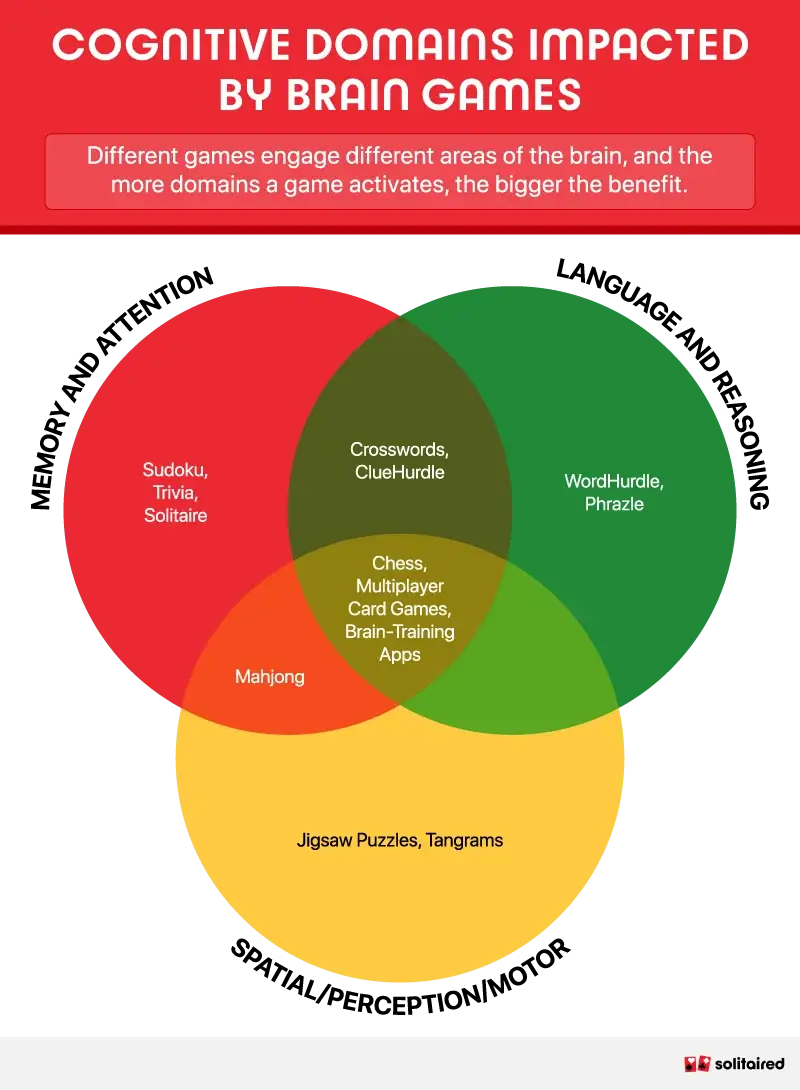
The more domains a game engages at once, the greater the benefit for your brain. Here are some of the best games you can play and the domains they strengthen. The following chart gives you a snapshot so you can scan the different types of games and their brain benefits.
| Game | Objective | Key Cognitive Domains | Benefit |
|---|---|---|---|
| Crosswords | Fill in words based on clues that test vocabulary and general knowledge. | Memory, language, attention | Stronger recall, improved verbal fluency |
| Word Games | Deduce hidden words or phrases by testing letter placement and patterns. | Working memory, language, problem-solving, attention | Expanded vocabulary, flexible thinking |
| Solitaire and Variations | Sequence cards strategically to clear the tableau. | Executive functioning, memory, attention | Better planning skills, improved focus |
| Mahjong Solitaire | Match tiles by recognizing patterns and sequences to clear the board. | Visuospatial, attention, memory | Stronger pattern recognition, enhanced recall |
| Multiplayer Card Games | Use strategy and recall to outscore opponents while adapting to their play. | Executive functioning, memory, problem-solving | Sharper strategic thinking, improved adaptability |
| Sudoku | Place numbers logically within a grid without repeating values. | Working memory, attention, processing speed | Sharper mental agility, faster problem-solving |
| Chess | Outmaneuver an opponent by strategically planning and adapting moves ahead. | Executive functioning, memory, problem-solving | Stronger foresight, flexible thinking |
| Trivia and Quizzes | Recall stored facts quickly, often under timed conditions. | Memory, processing speed | Faster recall, quicker mental responses |
| Physical Puzzles | Complete images, patterns, or shapes by arranging and fitting physical pieces together. | Sensation/perception, motor/construction, visuospatial, attention | Improved visuospatial skills, better hand-eye coordination |
| Brain-Training Apps | Target specific skills with short, structured challenges. | Memory, attention, processing speed, executive function | Convenient daily training that sharpens targeted skills and tracks progress over time |
1. Crosswords
Domains: Memory, language, attention
Why they help: Crosswords force you to retrieve facts from long-term memory while holding clues in mind (working memory). They also sharpen language and verbal fluency by constantly expanding vocabulary.
The gold standard of verbal games, crosswords challenge your vocabulary and long-term memory as you match clues to answers. They’re especially effective for strengthening recall because you have to connect language with stored knowledge.
2. Word Games
Domains: Working memory, language, problem-solving, attention
Why they help: Word games build mental flexibility because each attempt narrows the options, requiring you to remember what’s been tried while spotting new patterns. They strengthen working memory and attention while expanding vocabulary in a dynamic, deductive way.
Not all word games rely on definitions, like crossword puzzles. Some challenge your brain to think in spelling patterns and make logical conclusions for letter placement. Modern word puzzles like WordHurdle, don’t rely on guesswork. While deducing what letters logically fit, you hold possibilities in mind, test hypotheses, and adapt quickly based on feedback. If starting from scratch is too much of a head scratcher, you can play ClueHurdle instead, which offers a clue about the target word, so you can narrow down the possibilities from the start.
Phrase-based logic puzzles, such as Phrazle, take word games a step further. Instead of uncovering a single word, you must figure out entire expressions. This means juggling multiple moving parts, recognizing language patterns, and testing how words fit together, offering a deeper challenge for both working memory and problem-solving.
3. Solitaire and Its Variants
Domains: Executive functioning, memory, attention
Why they help: Solitaire requires you to plan sequences of moves, remember which cards are still hidden, and focus over time, all of which strengthen executive functioning and working memory.
More than a relaxing card game, Solitaire is a test of planning and problem-solving. Each move forces you to think ahead, track hidden cards, and adjust strategies when the tableau changes. And because there are so many Solitaire variations, you can always find a version that matches your skill level and keeps your brain challenged.
4. Mahjong Solitaire
Domains: Visuospatial reasoning, attention, memory
Why they help: Mahjong strengthens visual-spatial reasoning by requiring you to recognize patterns and see how pieces fit together. Mahjong has been linked to stronger recall and attention in older adults. More than just a tile-matching game, Mahjong Solitaire engages memory, attention, and pattern recognition.
5. Multiplayer Card Games
Domains: Executive functioning, memory, problem-solving
Why they help: Multiplayer card games combine recall (tracking which cards have been played) with decision-making under uncertainty. They train executive function by forcing you to adapt strategies based on how the cards fall as well as opponent behavior.
Multiplayer card games like Rummy, Cribbage, and trick-taking card games are structured around strategy, planning ahead, and adapting with changes. Whether you’re trying to shoot the moon in Hearts or outpace your opponent in pegging play during Cribbage, they require you to evaluate consequences, shift strategies quickly, and remember previous patterns to avoid repeating mistakes. The social aspect adds a layer of interaction that keeps the brain stimulated and makes the challenge more dynamic than solo play.
6. Sudoku and Number Puzzles
Domains: Working memory, attention, processing speed
Why they help: To solve Sudoku, you must hold possible numbers in mind while quickly testing options across rows, columns, and boxes. This strengthens working memory and attention to detail while improving your mental speed.
Sudoku challenges your brain to juggle multiple possibilities at once, strengthening the ability to hold and manipulate information. The constant need to test, eliminate, and confirm candidates trains your attention and improves mental agility. Although classic Sudoku isn’t a math puzzle, you can play variations that add mathematical elements to engage your brain in even more ways.
7. Chess
Domains: Executive functioning, memory, problem-solving
Why they help: Chess demands planning several moves ahead, anticipating your opponent’s strategy, and adjusting when circumstances change. That combination strengthens executive functioning while testing memory of rules, openings, and previous plays.
More than a pastime, chess is a structured mental workout and many consider it to be a classic brain training game. It challenges you to evaluate consequences, shift strategies quickly, and stay focused throughout long matches. The mix of foresight, memory, and adaptability makes it one of the most powerful games for sharpening higher-order thinking.
8. Trivia and Quizzes
Domains: Memory, processing speed
Why they help: Trivia games challenge long-term memory by asking you to retrieve stored facts quickly. The timed nature of many quizzes also helps improve processing speed under pressure.
Trivia games put memory to the test in a fast-paced format. They require you to pull facts quickly and accurately, which strengthens recall and helps your brain get better at retrieving information under pressure.
9. Physical Puzzles
Domains: Sensation/perception, motor/construction, visuospatial, attention
Why they help: Physical puzzles combine visual perception with hands-on motor skills. You have to recognize shapes, colors, and spatial relationships while manipulating pieces, engaging both perception and fine motor construction. These activities also reinforce spatial reasoning and sustained attention.
Building a jigsaw puzzle or solving a tangram is more than hand-eye coordination; it’s a full cognitive workout. The tactile element engages motor planning, while the visual element challenges perception and spatial problem-solving. For kids, these games support development of visuomotor skills. For adults, they offer a satisfying way to stay sharp across domains not always touched by digital puzzles.
10. Brain-Training Apps
Domains: memory, attention, processing speed, executive function
Why they help: Brain-training apps, available for both iPhone and Android, use short, structured games to target specific skills. For example, Lumosity focuses on attention and flexibility, while Elevate emphasizes reading and math.
Apps have become a popular way to practice brain training in short, structured sessions. Ones that focus on brain training, such as Luminosity, Elevate, Neuronation, and Peak, often focus on one or two skills at a time, making them useful for targeted practice in areas like attention or math fluency.
How to Choose the Best Brain Games
With so many brain games to pick from, the best choice often comes down to what you want to get out of the experience. Consider these tips:
- Start with your goals. Do you want to strengthen memory, build vocabulary, sharpen problem-solving, or simply unwind? Find a game, or several, that meet those needs for the skills you want to build.
- Consider your time commitment. Some games like expert-level Sudoku, chess, or crosswords can take much longer to finish than a quick session of WordHurdle. So select games that fit into the time slot you’ve set aside for brain training.
- Weigh your personal preferences. Because consistency matters more than intensity, the games you enjoy most are the ones you’ll keep playing.
By matching your goals, schedule, and interests, you’ll find brain games that are both fun and effective at keeping your mind sharp.
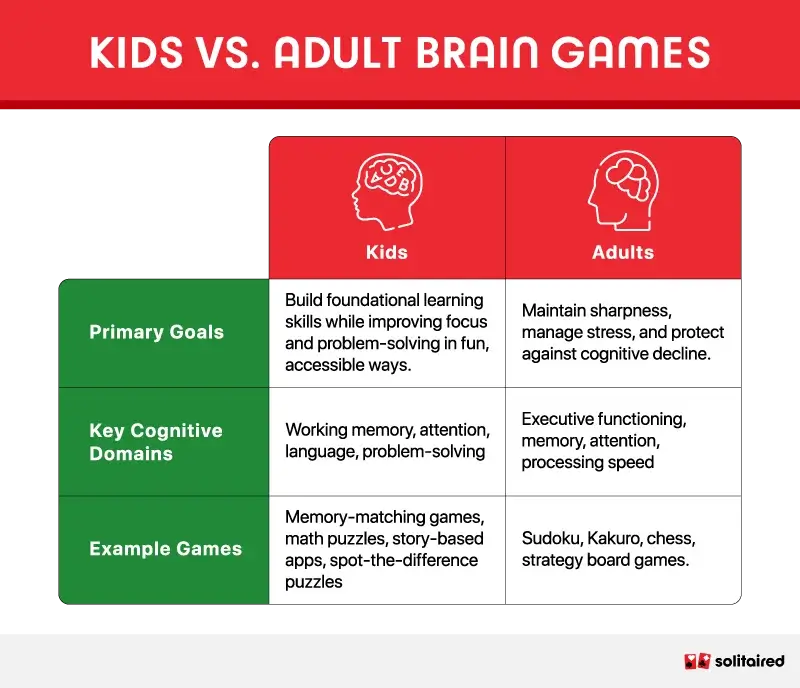
While many brain games are valuable for all ages, the scope of benefits often differs between children and adults. Kids need games that build core skills in a playful way, while adults benefit from puzzles that preserve mental sharpness, manage stress, and protect against cognitive decline. That’s why it helps to think about age-specific goals when choosing the best brain games.
Best Brain Games for Kids
The best brain games for kids combine learning with play, helping children strengthen focus, memory, and problem-solving while having fun. These games target domains most critical during development—working memory, attention, language, and problem-solving—helping kids strengthen the same skills they rely on in school and everyday learning:
- Classic puzzles like crosswords and Sudoku can be adapted for younger players, offering early practice with language and numbers.
- Games such as memory-matching cards or spot-the-difference puzzles build attention and working memory in accessible, bite-sized ways.
- Digital options like story-based puzzle apps boost reading comprehension and creativity.
- Hands-on games like jigsaw puzzles also play an important role, strengthening visuomotor skills by linking fine motor movements with shape recognition and spatial reasoning.
By keeping games enjoyable and age-appropriate, kids stay engaged while building the foundational skills that support academic growth.
Best Brain Games for Adults
For adults, brain games are most effective when they balance challenge with stress relief. These adult brain games effectively emphasize executive functioning, memory, attention, and processing speed, the domains most closely linked to long-term cognitive resilience and independence:
- Strategy-focused options like chess, Sudoku, or Kakuro demand sustained concentration, planning, and logical reasoning, strengthening executive functioning and processing speed.
- Classics such as Solitaire variations or Mahjong offer the perfect mix of relaxation and strategy, making them accessible for daily play while still sharpening focus and memory.
- Fast-paced activities like trivia and quizzes train recall and processing speed, while hands-on challenges like jigsaw puzzles enhance visuospatial reasoning and provide a calming break from digital screens.
By rotating between mentally demanding games and more relaxing ones, adults can maintain cognitive sharpness, manage stress, and protect long-term brain health.
The Science Behind Effective Brain Games
Brain games aren’t just for fun—they can engage parts of your brain linked to memory, focus, and problem-solving. While no single puzzle or app can “prevent” aging, research shows that playing regularly can help keep your mind sharp and may even slow cognitive decline.
Here are the traits that make them effective, plus examples of games that fit:
- Strengthens memory: Games like Sudoku, crossword puzzles, and Solitaire train short-term memory because you need to recall numbers, words, or card positions as you play. A large study of adults over 50 found that people who did number puzzles daily had memory performance similar to people eight to ten years younger.
- Improves executive function: Executive functions are the brain’s control skills, such as planning, flexible thinking, and self-control, and research shows card games and mahjong are linked with better executive functioning in seniors. Strategy games like chess or FreeCell Solitaire force you to plan moves ahead, adjust when things don’t work, and delay short-term rewards for better long-term results.
- Sharpens focus and attention: Studies suggest that people who play puzzles and card games regularly show better scores on attention and calculation tasks than those who don’t. Fast-paced puzzles and apps like Lumosity or Peak challenge sustained attention by timing your reactions or limiting moves. Klondike Solitaire also trains focus and attention because you have to plan ahead and pay attention to the result of cascading moves as new cards are revealed and put into play.
- May protect against cognitive decline: While games don’t cure or prevent cognitive decline, research shows they may help delay symptoms by keeping the brain engaged. In one study, older adults who played cards or Mahjong regularly scored higher on cognitive tests across multiple areas, especially those over 70.
- Provides stress relief: According to research, stress can impair memory and concentration. Relaxing games like Spider Solitaire or jigsaw puzzles give your brain a chance to refocus, offering you a mental reset.
Tips to Get the Most Out of Brain Games
Playing a crossword or round of Solitaire once in a while can be fun, but the real benefits come when you treat brain games like physical exercise. Here’s how to maximize the mental payoff:
- Play consistently. Aim for short, regular sessions instead of rare marathons. In one study, adults who did number puzzles daily outperformed less frequent players by the equivalent of eight to ten years in memory function. Tracking scores, times, or win rates makes improvement visible and motivates you to keep going.
- Vary the types of games you play. Because each game strengthens different domains, a mix keeps all areas of cognition active. For example, Crosswords boost language, Sudoku sharpens working memory, Solitaire builds executive functioning, and Mahjong enhances recall and attention.
- Increase the challenge. Just like lifting weights, your brain benefits most when you gradually increase the difficulty. Move from easy Sudoku to harder grids, or from Spider Solitaire 2 Suits to the four-suit version. Pushing into harder territory builds resilience and flexibility.
- Make it enjoyable! The best brain game is the one you’ll come back to. Pick games you genuinely enjoy so the habit sticks. Reducing stress while engaging your mind creates a double benefit for brain health.
With these tips, you can turn casual play into meaningful mental training. Platforms like Solitaired make it easy to rotate between Solitaire, crosswords, Mahjong, and more, so you’ll never run out of ways to challenge your brain.
Turn Playtime into Brain Training on Solitaired
Brain games do more than entertain. They strengthen memory, focus, and problem-solving by working key areas of brain health. From crosswords and Sudoku to Solitaire and Mahjong, the best results come from mixing games, playing often, and enjoying the challenge.
With Solitaired, you can access hundreds of these classics for free, including over 500 versions of Solitaire, daily crosswords, and timeless favorites like Seven and Whist. It’s an easy way to keep your mind sharp while having fun!
About the author