Click on a card. Lowest card gets the first crib.
You
Opponent
Drop a
card here
card here
Click on cards to start counting your points
Opponent's Crib
Drop 2 cards here
CRIB | YOU |  | 0 |
OPP |  | 0 |
CRIB
YOU
0
STND
0
| Your |
| Crib |
Pegging Count |
14 |
You drew the lower card!
You get the first crib.
You get the first crib.
No optimal play detected. |
Go with your gut! |
Computer says |
'GO' |
You must say |
All points are already counted. |
Opponent hand
1
points
Run of 3 for 3
Reshow
count
count
0
points
That is not the
optimal discard
optimal discard
Your discards will result in an average round score of 0.0
A better play exists that would result in an average score of 0.0
A better play exists that would result in an average score of 0.0
You win!
Skunk!
| You | Opponent | |
| Total score: | 107 128 | |
| Pegging: | 107 128 | |
| Hands: | 107 128 | |
| Cribs: | 107 128 | |
Sub-Optimal Discard Plays
Hand dealt - Opp. crib
You played
avg
1.9
points
Optimal play
avg
1.9
points
| Run of 4 for |
| 29 |
| points |
How to Play Cribbage
Cribbage is a two-player card game where the goal is to be the first player to score 121 points.
Cribbage Setup
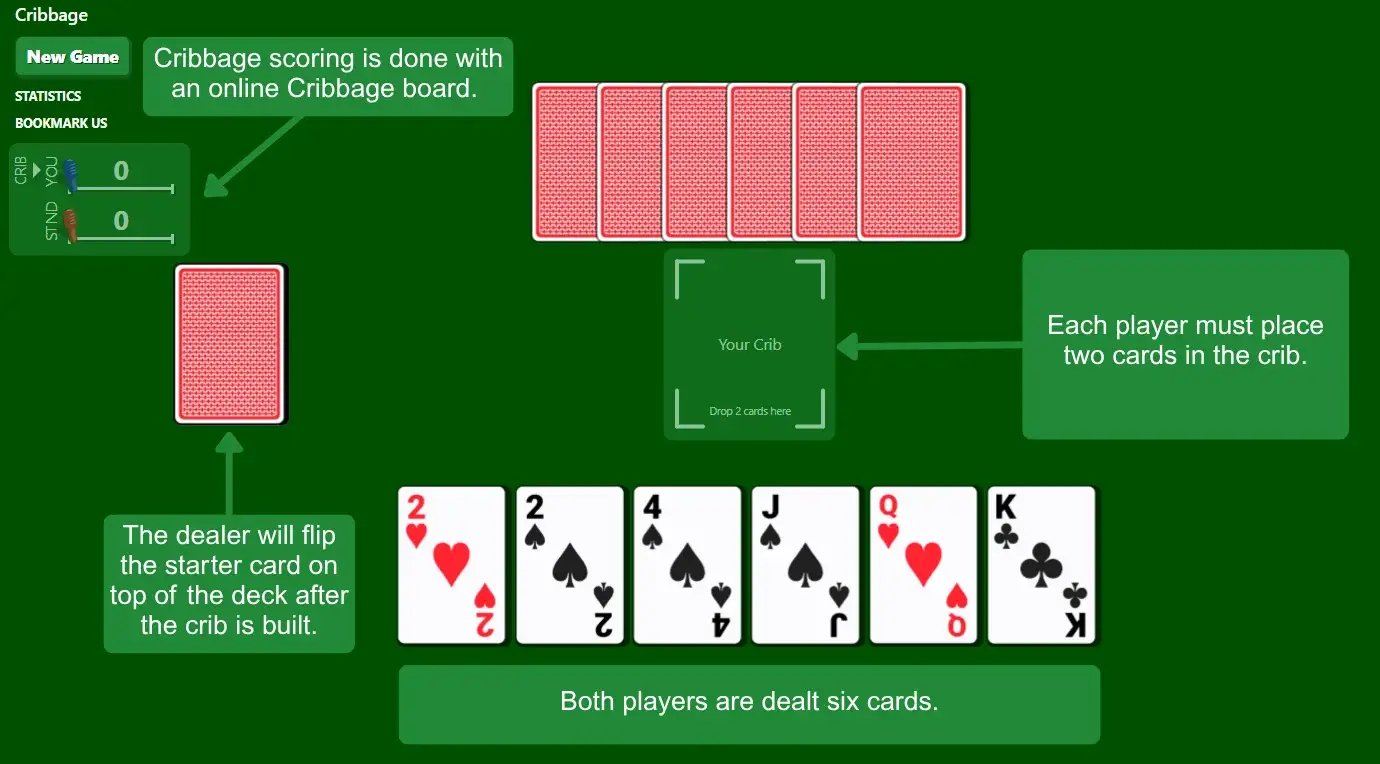
Cribbage uses a standard 52-card deck (aces low) and is set up as follows:
- Hand: Each player is dealt six cards to start each hand. The rest of the deck is placed facedown in the game area. The players alternate the task of dealing each hand.
- Crib: Each player chooses two cards from their hand to discard facedown into the crib, which is a bonus hand that the dealer gets to score after the hand is played. The crib is set to the side.
- Starter card: After the crib is built, the dealer turns the top card of the deck face-up. This card will be used only for scoring after the hand is played.
- Cribbage board: The cribbage board or online scoreboard pegs points for each player as you score the game.
Cribbage Rules
Each round (or hand) of Cribbage is broken into three phases. Read our detailed guides for more information about how to play Cribbage and Cribbage scoring.
Building the Crib
- Each player must place two cards facedown into the crib. If it’s your crib, you can add valuable cards to it like doubles or cards that add to 15, but if it’s your opponent’s crib try not to add any cards that could help them score.
- The crib is set aside for the dealer. Because you alternate dealers, each player gets a turn to use the crib as a bonus scoring hand.
- After the crib is built, the dealer turns over the starter card. The starter card won’t be used during gameplay. It’s used during the scoring phase to enhance the score of each hand and the crib.
Playing the Hand (Pegging Play)
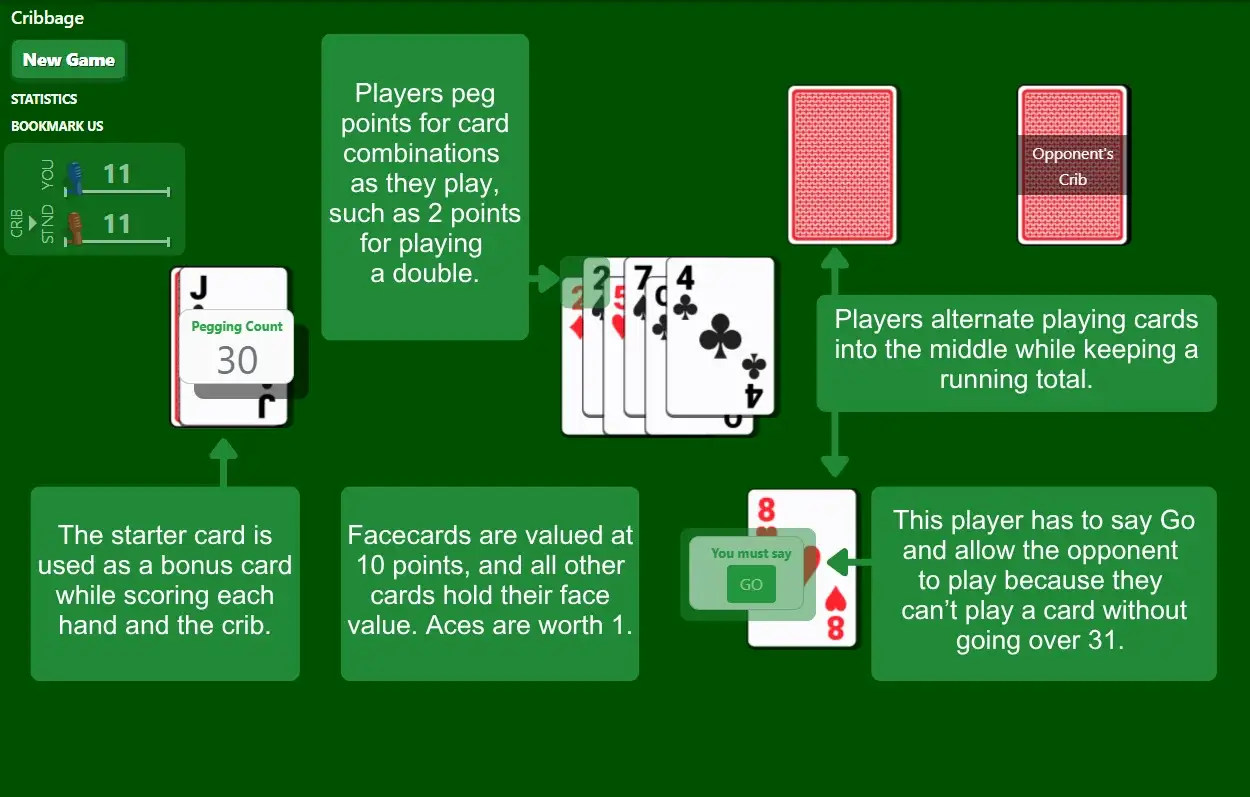
- Players alternate playing one card into the middle, adding that card’s value to the total without going over 31. Play begins with the non-dealer.
- All face cards are worth 10, and the ace is worth 1. Each card adds its value to the running total. For example, if the non-dealer lays down the 4♥ followed by a 9♣ by the dealer, the total becomes 13.
- Players peg points for making combinations as they play. The same combinations that are scored for each hand can be scored during pegging play. For example, the 4♥ and 9♣ have been played for a total of 13, but if the next player adds a 2♠ to make 15, that player pegs 2 points.
- If playing a card from their hand causes the total to go over 31, the player must say, “Go.” For example, if the total is 27 but the next player doesn’t have a card ranking 4 or lower, they must say, “Go,” and allow the opponent to play until they can’t play any longer.
- Players peg 1 point for laying down the last card and 1 extra point if the last card played makes 31. For example, if the total is 28, and the last card played is a 2♦, totaling 30, the player gets only 1 point. However, if the last card played is a 3♠, totaling 31, the last player gets 2 points (1 for playing the last card and one for totaling 31).
- Play as many rounds needed until neither player has cards left.
Scoring the Hands and the Crib (the Reveal)
- Each player takes turns scoring their hand, beginning with the non-dealer.
- The starter card can be used as a bonus card for each player when scoring. For example, if the starter card is a jack and a player has a five in their hand, they can score 2 points for making 15.
- The dealer gets to score the bonus crib, using the starter card to boost their score.
- As soon as a player reaches 121 points (even during pegging), the game ends and that player wins.
| Card Combination/Play | Points Scored | Example |
|---|---|---|
| Last card played (total under 31) | 1 | The total is 29 and you play an ace for a total of 30. |
| Last card played (total exactly 31) | 2 | The total is 25 and you play a six for a total of 31. |
| Cards that add up to 15 | 2 | Ten and five or a two, three, and queen |
| Pair of cards (two cards of the same rank) | 2 | Two of clubs and two of hearts or queen of spades and queen of diamonds |
| Run of three (regardless of suit) | 3 | Ace, two, three or jack, queen, king |
| Run of four (regardless of suit and order as long as cards are consecutive) | 4 | Ace, two, three, four or seven, nine, six, eight |
| Run of five (regardless of suit and order as long as cards are consecutive) | 5 | Ace, two, three, four, five or three, five, six, four, seven |
| Three of a kind | 6 | Three of spades, three of diamonds, and three of hearts |
| Four of a kind | 12 | Three of spades, three of clubs, three of diamonds, and three of hearts |
| Four-card flush (four cards of the same suit, regardless of sequence) | 4 | Queen, ten, four, and three of diamonds |
| Five-card flush (all cards, including the starter card, are the same suit) | 5 | Queen, ten, four, three, and ace of diamonds |
| Nobs (the jack in your hand or the crib is the same suit as the starter card) | 1 | Starter card is a nine of spades, and you have the jack of spades |
| Nibs (also called “his heels”; dealer turning up a jack as the starter card) | 2 | Dealer turns up a jack of diamonds as starter card |
Cribbage Strategies
- Keep scoring combinations in your hand. When discarding to the crib, prioritize keeping cards that can make runs or pairs or add to 15 instead of hoping the crib or starter card will make up the difference.
- Discard defensively when it’s your opponent’s crib. Avoid tossing cards like fives, tens, or pairs that easily form scoring combinations—you don’t want to feed points to your opponent.
- Be aggressive when it’s your own crib. Send cards to your crib that are likely to work well together, such as fives, pairs, or cards that add up to 15.
- Lead low during pegging. Starting with low cards reduces the chance that your opponent can hit 15 early in play.
- Avoid leading fives, tens, and face cards when possible. Leading with any of these cards helps your opponent score an easy fifteen.
- Track what’s been played. Your opponent has a strategy, so watching what they play may signal what they’re holding.
- Maximize runs and pairs during pegging. Look for opportunities to score by continuing or breaking runs, or by pairing your opponent’s cards when possible.
- Manage risk near the finish. When you’re close to 121 points, avoid risky plays that could give your opponent easy pegging points—focus on safe scoring and closing out the game.
If you like multiplayer games, you can try playing Hearts, Whist, Gin Rummy and Spades.
